



Automotive industry trends 2026: Full speed ahead

February 3, 2026 10 min read
Automotive industry trends 2026: Full speed ahead
In 2025, several key trends significantly propelled the auto industry forward. Electric cars kept changing the way people think about buying and owning vehicles. By now, most people expect some sort of self-driving features; it’s no longer just a flashy extra. AI has found its way into nearly everything, from the design and construction of cars to the way drivers interact with their vehicles on the road. Cars weren’t stuck the way they rolled off the lot, either. Thanks to smarter software, they continued to improve long after you bought them. And through all of it, semiconductors held everything together. They were the quiet heroes behind every innovation.
And don’t forget about evolving consumer preferences. Looking ahead to 2026, it’s not enough just to keep up with new trends; you must scale them in a way that actually works and generates revenue. What’s coming next? People want supply chains that talk to each other, tighter connections with OEMs, better cybersecurity, and smooth, simple experiences at every turn. The brands that get ready for all this now won’t be left scrambling down the road.
Key takeaways on the automotive industry
- Software is now the true differentiator. Thanks to OTA updates, comprehensive audit trails, and more refined release strategies, cars have moved beyond static products—they’re now platforms you can continually upgrade and refine.
- Autonomy’s momentum isn’t fading. Investment continues to flow, with the industry pushing for safer roads, more personalized driving experiences, and smarter shared mobility.
- AI agents are finally living up to the hype. They’re not just a buzzword—they’re actually automating service, warranty, parts, and customer interactions that used to consume significant time industry-wide.
- The practical aspect of electrification is growing. While EV sales are adjusting to the current situation, hybrid vehicles are on the rise. Flexibility, affordability, and the creation of reliable charging infrastructure must now be top priorities for brands.
Software-defined vehicles and OTA updates
OTA updates enable auto manufacturers to send new software directly to your car over Wi-Fi or cellular networks. It’s a lot like updating your phone, but here, the changes can touch everything from your dashboard’s apps to advanced driver-assist features, as long as the car’s built for it.
For software-defined vehicles, OTA is far more than just convenient. It’s the backbone. A/B updates mean your car keeps one stable version running while it loads the latest one in the background, so there’s barely any downtime. If something’s off, it instantly rolls back to the safe version. Automakers typically begin these updates with a small batch of cars first, ensuring everything checks out before rolling it out to the general public.
Automotive software updates can get pretty big, and let’s face it, network connections in cars aren’t always reliable. That’s where delta updates make a real difference: they just send what’s changed instead of the whole package. This means less data and quicker installs. To keep everything running smoothly, software configuration management ensures that versions are aligned across all ECUs, hardware, and dependencies. Throw in detailed audit logs, think timestamps, version changes, even success rates, and now you’ve got an OTA process that’s not just fast, but ready for compliance.
Progress in autonomous driving technology
In 2022, the global autonomous vehicle market reached a value of $1.5 trillion. By 2030, the global economy is expected to reach nearly $13.6 trillion. That’s a significant jump, and it demonstrates just how rapidly companies are investing money and energy in this space.
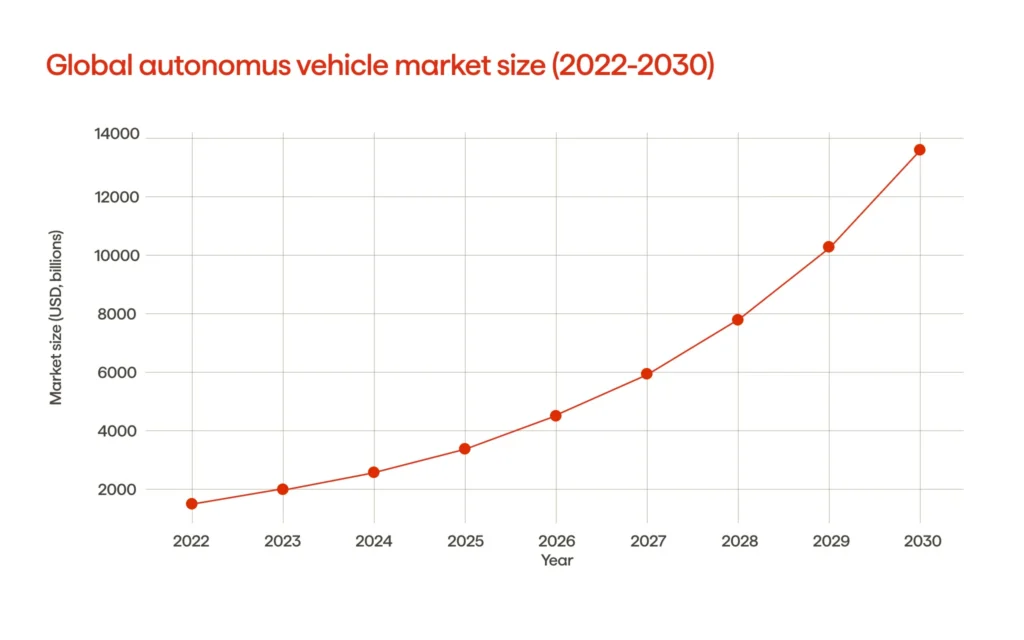
Here’s what’s driving that growth:
- Highly automated driving is getting real. Cars are taking more control, blending data from more sensors, and handling complex situations better—all across a broader range of models, not just the high-end ones.
- It’s not just about private cars anymore. Fleets of robotaxis and shuttles are showing up in more cities. They are used much more frequently than private vehicles, so companies see returns on their autonomous technology more quickly.
- Autonomy and electric vehicles are strongly related. EVs are ideal for self-driving systems because they have centralized computers, simplified mechanical systems, and software at their heart.
- Automobiles are becoming more intelligent about their occupants. Every trip seems customized for the driver, thanks to AI’s personalization of the entire driving experience, including navigation, driving style, and cabin comfort.
AI agents that work like extra team members
AI agents in the automotive world are like intelligent assistants that actually get things done—no more waiting around for someone to babysit every task. They connect directly with your DMS, CRM, telematics, parts catalog, scheduling systems—all of it—and just keep things moving.
Picture the service lane at a dealership. An agent recognizes a diagnostic code sent from the OEM telematics feed. It chooses the following line of action after quickly checking the customer’s mileage, warranty, and any pertinent TSBs or recalls. Before anyone at the counter even raises a finger, it might schedule a service appointment, complete a repair order, and even pick up the appropriate part. If that part’s backordered, the agent doesn’t stop—it looks for another supplier, offers a different appointment date, or flags a substitution for someone to approve. Essentially, it handles the details, allowing your team to focus on more significant matters.
On the customer’s side, the same agent does the administrative work that improves customer satisfaction. This entails answering customer status questions (such as “Is my vehicle ready?”), giving customers clear ETAs, renting cars based on inventory availability, and providing them with one-tap buttons to confirm their approvals.
Accelerate your automotive innovation and bring products to market faster with custom automotive software development.
Supply chain connectivity that actually works
When supply chain connectivity truly works, everyone looks at the exact numbers—planning, production, logistics, after-sales, and so on. No more back-and-forth over whose spreadsheet is accurate. OEMs and suppliers nearly instantly connect forecasts, inventory, shipment monitoring, and quality updates. With this kind of visibility, you can spot problems before they stop your assembly process, such as a tier-2 part that is running late. In today’s automotive industry, teams can move swiftly by rerouting shipments, finding backup suppliers, and adjusting production as needed, thanks to connected data. The hiccups get handled before customers even notice.
Electrification and the infrastructure catch-up
Electrification continues to drive the auto industry forward, but the charging infrastructure is still playing catch-up. That’s why carmakers and their partners are investing money and effort not just in the cars, but in the entire experience. They’re teaming up on smarter navigation that actually locates working chargers, seamless plug-and-charge payments, and even battery technology that speeds up charging at the plug. The next big leap in vehicle tech isn’t only about stretching range. It’s about making charging feel as reliable and straightforward as filling up at the pump used to.
Seamless integrations with OEM brands
In 2026, seamless OEM integration enables your dealer, fleet, or mobility platform to access the same data the manufacturer uses, almost instantly. Service, sales, and parts teams stop wasting time chasing down mismatched records. Take service departments, for instance. They lean on OEM technical portals and bulletins just to keep up. Toyota’s Techinfo/TIS, for example, locks down access to TSB-driven tools and reprogramming instructions behind a subscription.
When it comes to vehicle data, OEM-level telematics APIs have become the gateway into dealer CRMs and DMS systems. It’s similar to what Tesla does with its Fleet API—fleet managers gain direct, programmatic access to everything they need for operations and integrations.
Get this right, and you see real results. Recalls and warranty claims move faster. Parts ordering gets simpler. Customers see a single, up-to-date view of their vehicle, whether they’re using an OEM app or working with a dealer. The bottom line? Car sales and aftersales get a whole lot smoother, everywhere.
Intelligent customer journeys & experiences that drive loyalty
These days, purchasing a vehicle is similar to a dynamic system that changes depending on the customer’s actions. Customers may find a car they like on Instagram, compare trim levels on an automaker’s app, contact a dealership via Messenger, and schedule a test drive all in the same day. The businesses that stand out from the competition are those that make the entire process simple for customers.
In practice, AI comes into play to personalize offers based on what shoppers actually browse online, send timely follow-ups after someone customizes a car online, and keep owners engaged long after the purchase.
Loyalty grows when people have experiences they’re eager to share. Imagine exclusive EV road trips by invitation, test drives led by creators, or service lounges designed for content creation—all linked to a single identity and rewards program. This approach keeps vehicle sales connected with ownership, subscriptions, and repeat business, even as cars become more personalized and software-driven for today’s automotive customers.
| Journey moment | Data signal | Experience trigger | Loyalty outcome |
|---|---|---|---|
| Discovery | Configurator clicks, content saves | Personalized trim and payment options | Higher lead-to-test-drive rate |
| Shopping | Trade-in quote, dealer chat history | One “handoff-free” conversation | Faster decisions, fewer drop-offs |
| Ownership | Driving patterns, diagnostics | Proactive service, in-car personalization | Better retention, add-on revenue |
| Community | Event attendance, UGC | Shareable experiences + rewards | Advocacy and repeat purchases |
Hybrids take the lead as EV adoption recalibrates
The most significant shift in the automobile industry in 2026 may be a sign that electrification is required. Although there is still a push for 100% electrification, consumers are becoming more savvy and demand a wider variety of products. Data from early 2025 indicate a slowdown in sales of new retail electric vehicles, accompanied by an increase in sales of hybrid cars. By the end of 2024, approximately 60% of electrified vehicle sales in the U.S. were hybrids.
Deloitte’s 2025 Global Automotive Consumer Study finds that interest in EVs remains relatively moderate in many regions, but more consumers are considering hybrids and range extenders. These options just seem like the practical middle ground at the moment.
FAQ
Final words: The future of the vehicle market
The Top Gear team never shied away from sharing their thoughts on modern cars. Clarkson put it simply: “I just like the sound of the V8.” You can see his point. However, even though the automotive world may seem like something out of science fiction, it can still strike a balance between innovative design and the thrill of driving.
If you’re looking for a solid plan for your next car market move, contact Avenga, your trusted partner in the automotive sector.

Generative AI for retail: The top examples and use cases changing CX

AI for credit risk management: Embrace banking innovation in 2026

Telecom billing software systems: A comprehensive guide
Your business results matter
Achieve them with minimized risk through our bespoke innovation capabilities. Fill in the form below.