






How AI is used to prevent telecom network failures


October 28, 2025 11 min read 473 views
In telecommunications, this is not poetry – it’s either profit or loss. The networks expand across every part of the globe; traffic spikes, and one missed alarm will cascade into churn, requiring rebates and a report on the front page. This is why, for telecom operators, AI systems are not just shiny new toys. They act as quiet colleagues, watching for patterns, alert to drift, and nudging the network back into proper shape before the customer experiences it.
This article is all about the practical side of the shift: how telecom operators use AI to predict faults, reduce MTTR, and maintain service quality at scale. We will stay out of the lab and remain in the NOC, focusing on anomaly detection that actually reduces noise, maintenance performed before a radio failure, and closed-loop actions that optimize the RAN, transport, and core without violating policy. We will cover what a customer cares about most: when the network can personalize the protection of VIPs, slices, and mission-critical applications during a bump.
Key takeaways for the telco AI market
- Artificial intelligence has made its way into operations. In telecommunications, AI is often employed in runtime operations, detecting anomalies, predicting failures, and stabilizing networks without the need for additional hardware.
- Reliability is sustained through early warning systems and closed loops. Anomaly detection, predictive maintenance, and policy-guarded remediation reduce mean time to recovery (MTTR), mitigate outages, and keep radio access networks (RAN), transport, and core networks within established KPIs.
- Value manifests in unequivocal metrics. Market adoption is increasing everywhere as AI reduces maintenance costs and downtime, cuts customer churn (and acquisition costs), and defers capital expenditures (CapEx).
- Execution is as important as the models. To achieve sustainable gains, a commitment to data quality, MLOps, clean OSS/BSS integration, and governance is required.
Overview of AI in telecom
AI in the telecommunications market has shifted from proof-of-concept to day-to-day use in operational workflows. Companies are leveraging AI to monitor anomalies, predict failures, accelerate safe repairs, and enhance performance without the need for additional hardware. This yields fewer surprises for the NOC and enhances the customer experience.
How service providers use artificial intelligence today
To put it plainly, AI in telecommunications has now moved from slides to sockets. Operators are now relying on AI to maintain quiet networks and keep customers satisfied. Let’s start with the front line: support. Generative bots understand intent, summarize the interaction, and recommend the next best action, reducing handle times while increasing customer satisfaction. When a VIP calls about jitter, AI surfaces cell events, device telemetry, and known issues, allowing the agent to resolve the problem in the first pass – eliminating ping-pong between tiers.
In the background, AI models monitor the grid. Time-series models monitor thousands of counters per site and detect drift well before alarms trigger. When the error rate signals an imminent failure, the system schedules a swap for a low-traffic period and shifts the load as necessary. That same learning loop tunes the RAN, with tilt, power, and handover thresholds updated to ensure performance and quality remain stable during peak hours. Fewer truck rolls, fewer dropped calls, and much improved MTTR without additional hardware.
Automation is much more than “self-healing.” Robotic process automation shifts the tedious and dangerous work—such as closing duplicate alarms, reconciling inventory, and validating configurations—into a manageable state. With guardrails, RPA can invoke a safe rollback when a change causes KPIs to degrade to an unacceptable level, or create a ticket with the logs and suggested fixes when approval is needed. On the revenue protection side, anomaly and graph models detect SIM-box churn, suspicious roaming patterns, or account takeovers in real time, blocking the bad while legitimate traffic flows.
AI can also be used to notify the business. Forecasting models advise planners about where to add capacity in the next quarter, and when to economically power down lightly used carriers. Marketing teams become smarter as well. Churn and propensity models offer time-sensitive promotions to customers who actually want them—without carpet-bombing inboxes. Data is the connective tissue, whether it is an alarm, PM counter, CDR, probe Data, or logs stitched together into features that models can comprehend. A competent telecom software development company earns its keep in this space by building pipelines, feature stores, and MLOps to deploy models cleanly and continue to learn.
Industry snapshot
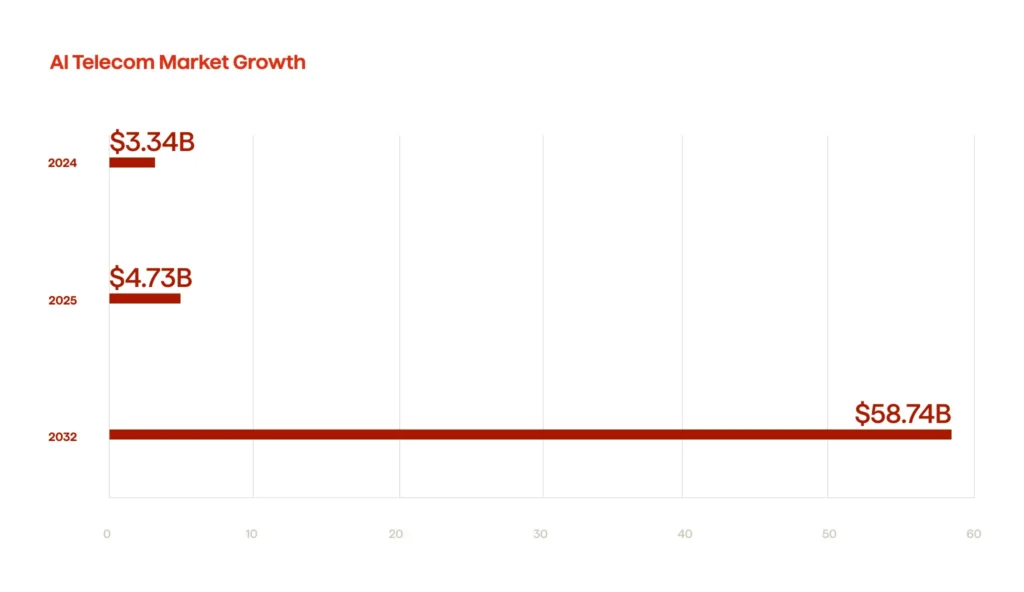
The global AI in telecom market was valued at $3.34 billion USD in 2024 and is expected to grow from $4.73 billion USD in 2025 to $58.74 billion USD in 2032 at a 43.3% CAGR.
A 2024 Nvidia study found that the use of AI among telecoms reached ~90% (48% of telecoms are piloting, and 41% of telecom companies are using it in live deployment). 53% of service providers agree or strongly agree that AI gives them a competitive advantage. McKinsey reports that AI can help improve sales conversion by up to 15% and reduce capital expenditures by up to 10% through better planning. In short, investment is accelerating because the value is experienced in tangible metrics, and AI delivers improved network performance, fewer downtime incidents, and better customer satisfaction.
Key AI use cases for network reliability
Although the industry insights are helpful, the value lies in understanding how AI technologies are utilized to maintain the reliability of telecom networks in daily operations. This section shifts the scope from market figures to a practical implementation: how advanced AI integrates into real network operations to detect anomalies at an early stage, thereby avoiding outages and facilitating safe remediation. In short, how operators are converting models into uptime.
Anomaly detection and early warning
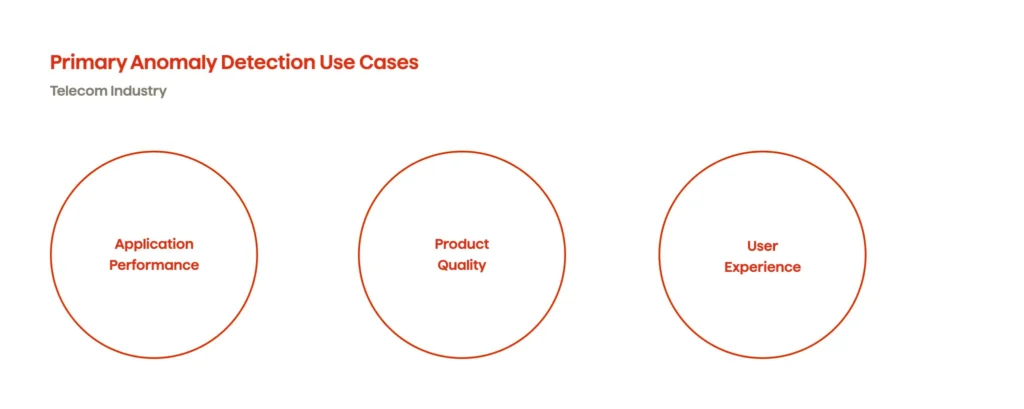
In the telecommunications industry, anomaly detection is one of the most actionable AI use cases for telecom because it produces early warning systems from noisy telemetry. Operators utilize unsupervised models and dynamic baselines to detect drift issues before alarms reach their threshold. More specifically, telecommunications providers need AI solutions for:
- Application performance. If a self-care app’s login latency or 5xx rate spikes in one region, AI applications will flag that event and connect it to the recent API change. Traffic is rerouted temporarily, and the build reverted—within minutes, rather than longer.
- Product quality. After a CPE/handset firmware update, models compare error signs, including battery drain, observed after the update to those observed before the update. If a specific version exhibits a degradation in radio attach success rates, the system halts rollout and targets a hotfix only to the affected devices.
- User experience. Experience analytics traces anomalies not just to cells, but people. Suppose a VIP segment or an enterprise slice exhibits an increase in packet loss. In that case, the platform will initiate policy-defined QoS boosts or targeted path changes—a service response that customers can perceive.
Predictive maintenance (RAN, transport, core)
Telecom maintenance with AI becomes more about probabilities than guessing. Time-series and survival models can quantify the failure risk of the RAN (radios, baseband units, power units), leveraging metrics such as temperature drift, voltage standing wave ratio, and error counters, to predict the remaining useful life. Within the transport layer, models monitor optics, fiber attenuation, and CRC burst rates to flag a link that may be flapping, allowing a traffic steer and swap to be scheduled during a maintenance window when traffic is low. At the core, VNF and CNF anomaly patterns demonstrate a license-degrading or control plane KPI anomaly that identifies nodes to reset before a session drop becomes unmanageable.
These AI capabilities reduce truck rolls, prevent catastrophic outages, and improve spares and workforce planning, reducing operational costs. The playbook for this work is simple: score health on a daily basis, automatically create work orders when thresholds are passed, and verify fixes with post-maintenance KPIs. The outcome is fewer emergencies, faster MTTR, and more consistent service without overbuilding capacity.
With a team of over 1000 dedicated experts and more than 30 years of experience, we specialize in transforming the performance of telecommunication companies.
Fault localization and closed-loop remediation
When parts of the telecommunications infrastructure wobble, the objective is to be fast and maintain control. A fault-correlation model will thread together alarms, counters, and logs, producing a definitive root cause and isolating the malfunctioning cell, backhaul link, or core node. A policy-guarded loop is then deployed: detect → decide → act → verify, with safe reroutes, reset parameters, or configuration rollbacks, all with a complete audit trail.
Gen AI is integrated as a copilot in the process—summarizing alerts raised, providing explanations of likely causes derived from historical tickets/content, and suggesting possible remediation steps for human approval, among other features. Impact models also allow for premium service, as VIPs, slices, or critical IoT traffic are temporarily prioritized while the loop stabilizes the network. By the way, Ericsson’s efforts in researching hybrid AI for enhanced operational fault management are a glimpse into the future — learning systems, augmented with human validation, adapted for better reliability.
Common implementation nuances
The benefits of reliability rely on execution as much as it does on the algorithm. Achieving sustained results requires adherence to data quality, MLOps at production quality, OSS/BSS connectivity, and governance that enables safe and auditable automation.
Data quality, MLOps, and integration with OSS/BSS
AI performance is dependent on the availability and quality of data it has access to. Telecom data is notoriously noisy—missing counters, clock skews, vendor quirks—and real fault cases are sparse.
It’s highly recommended to begin with hygiene: align timestamps, normalize units of measure, address outliers, and codify features that a NOC/SRE can actually trust. Treat labeling as a product—with weak supervision, synthetic fault labeling (e.g., windows post-incident), and human review of the top cases failing the service. Then, organizations should prioritize establishing MLOps early. Version datasets, models, and features; track drift and false-positive rates; shadow models for a period before launch; and maintain a clean rollback path.
Integrating the new AI/NLP/ML element stalls many pilots. Expose stable APIs into the old OSS/BSS/NMS. Map actions to change control; log every action into the observability stack that the operators are already using. If you are inferring at the edge, whether RAN/PE, you should consider light-weighted models, flaky links, and remote updating.
Governance, safety, and change management for service providers
A closed loop does not mean a closed door; you need to provide clear guardrails around “what is allowed, on which assets, what thresholds, and who approves the action.” At all times, ensure that humans are always involved in high-risk changes, let automation manage low-risk fixes, and always ensure a full audit trail exists. Build explainability from the start because operators need to understand “why” a decision was made, which features mattered, and how risk was considered.
Coordinate across markets for privacy and sovereignty criteria (PII, retention, and cross-border flows), and create and publish runbooks to connect model outputs to actionable operational plans.
Train the NOC, field, and IT together to avoid ticket ping-pong. Begin with opt-in domains and measure impact (MTTD/MTTR, truck rolls avoided, QoS deltas) before scaling efforts. Finally, lock in vendor terms early (data portability, IP ownership, exit terms, support SLAs) to prevent quick wins from turning into long-term lock-in.
FAQ
From firefighting to foresight with telco AI
Reliability has become a feature of products, and AI in the telecommunications market is burgeoning because operators can leverage it: fewer outages, faster recoveries, and consistent external QoS. The next step is pragmatic AI for telecom — closed-loop automation mechanisms with clear guardrails, so models translate into uptime customers can trust.
Want to learn more about AI use cases in the telecom industry? Contact Avenga, your trusted telecom software development company.



Your business results matter
Achieve them with minimized risk through our bespoke innovation capabilities. Fill in the form below.