



AI development cost in 2026: Your ultimate guide


January 28, 2026 10 min read
The discussion around artificial intelligence (AI) has greatly evolved. It is no longer a question of “if” a business can utilize AI; it is at what speed it can move, and what AI investment makes sense for them. The stakes are high as McKinsey highlights AI use cases could drive $4.4 trillion in productivity growth potential across the corporate environment.
But where there is opportunity, there will be complexity: every organization asks, “How much will it cost to build an AI solution that works?” The answer depends on your plan, project size, and the development company you partner with. Although there’s no flat fee, you can estimate common patterns and cost drivers before making the final investment. Here’s a closer look at the key factors that influence AI project pricing.
Why understanding AI development cost matters
AI adoption is already happening faster than most leaders expected. According to a recent poll American professionals are integrating AI into their work at an unprecedented rate, particularly those in technology fields, where adoption rates are highest. Many employees are already using these tools daily. A McKinsey study reveals this gap: while C-suite executives project widespread adoption over the next one to five years, the reality is that implementation is already underway (see Graph 1).
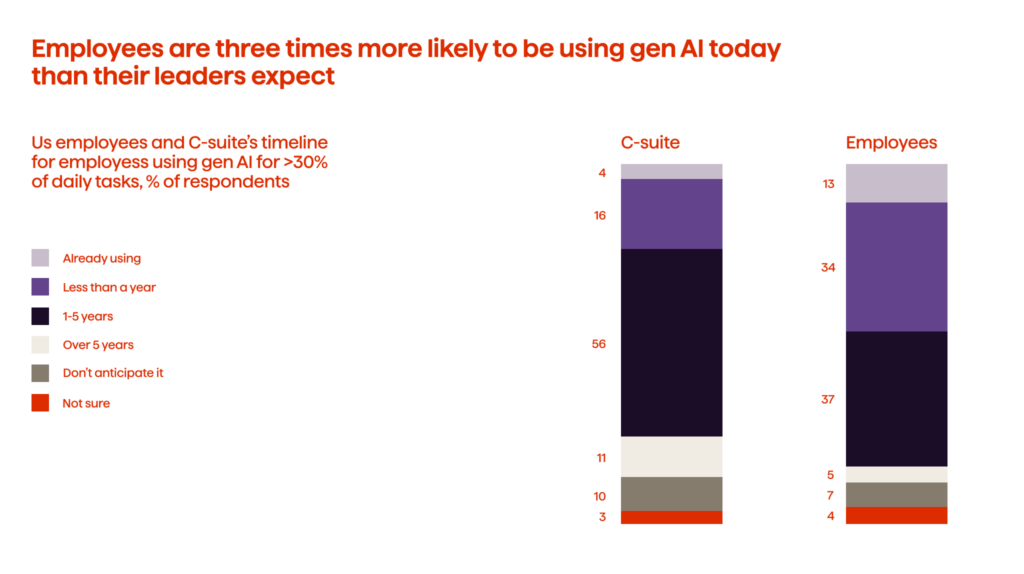
The perception gap illustrates why understanding AI costs is essential. Some organizations underestimate two things:
- How quickly AI is embedded into workflows
- How resource-intensive building a scalable AI solution can be
The result is that companies are in a race to the finish line, engaging in AI development without a budget, going with short-term fixes instead of committing to sustainable AI solutions, and ultimately, are spending too much money on maintenance and rework. These wrong turns can’t accelerate transformational change, delay meaningful progress, and dilute ROI.
This underestimation has process ramifications. When AI gets more adoption than a leadership team ever imagined, it’s common for companies to fund small pilot projects without planning for scale. In isolating these quick wins, they create a patchwork of disparate systems, with IT teams forced to build retroactive integrations, which become much more expensive. True scalability for more complex AI systems requires stronger data infrastructure, a robust data governance framework, and specialized talent; these are not things to build reactively.
In these rushed initiatives, the full costs of technology are not factored in if they use temporary cloud credits or third-party APIs, as usage rises and these fees grow. These investments can become an unexpectedly large operational expenditure. Talent shortages (i.e., experienced data scientists or machine learning engineers) are expensive and already scarce, making the cost of implementing AI even more compounded.
Key factors influencing AI development cost
The cost of developing an AI project is more than just the hourly rate of an AI developer. Each AI model, dataset, and integration decision impacts the amount of time, expertise, and infrastructure required.
Scope and complexity of the AI solution
First, and most importantly, the project scope is likely the primary factor driving AI software development costs. A simple customer-facing virtual assistant typically requires a pre-trained large language model (LLM), basic prompt engineering, and limited domain-specific customization. More complex features require senior-level AI expertise and extensive testing. In highly regulated sectors such as healthcare and banking, stringent requirements for explainability and security add complexity, lengthen development cycles, and drive up costs.
Data availability and preparation
Data is the oxygen of AI, and the quality of the data often dictates the resources and time required for an organization’s AI implementation before any training can occur. Companies with structured, pristine data have an advantage in efficient training models. If a business starts from scratch, most of the legwork should be done to source, clean, and label data to make it fit for model training. For example, you would need thousands of accurately tagged, high-quality images with high pixel resolution to develop a computer vision AI model. This can easily ramp up the time and cost. Plus, even after the data has been prepped, regulatory frameworks that govern data management should be observed to maintain compliance and mitigate bias, adding another layer to the total cost.
As a case in point, Tesla uses models to determine vibration detection during the production of electric vehicles, so that tiny imperfections coming from parts can be nabbed early in the production line. Achieving this level of sophistication would require the company to have thousands of high-resolution, labeled images used for model training and effective data pipelines that can manage the real-time video feed data from the manufacturing lines.
Model development and training
AI development takes two primary paths: refining pre-existing models or designing custom neural networks. When you reuse or refine existing trained models or open-source AI algorithms, the marginal cost of your work is minimized. However, for precise problem definitions, you might need to build your solutions using architectures you design from the ground up. This will include more training development cycles, hyperparameter tuning, and experimentation. The amount of computer resources needed for these cycles is so high that you require specialist cloud resources or a GPU setup for enterprise computing. The more cycles you have to perform to get your model to reach optimal performance, the more costs escalate. Hiring AI developers and data scientists with advanced skills only adds time and additional expenses to developing advanced systems.
Integration and deployment
An AI tool only has value once it seamlessly integrates into existing software ecosystems and workflows. The deployment process often reveals additional challenges like infrastructure scaling, security layers, and existing systems requiring API development. Whether the deployable solution will exist in a hybrid environment, co-located, or on the cloud impacts both one-time and recurring costs. Some of the best-planned projects typically have operational budgets beyond the original development phase, including fees for continuing model monitoring, retraining, and systems upgrades post-deployment.
Typical cost ranges for AI development
When companies ask, “What’s the cost of developing an AI solution?” The answer depends on the level of project complexity and the development involved. Clutch data indicates that many AI engagements fall within the $10,000–$49,999 range, which reflects the fact that a large share of AI initiatives remain at the POC, pilot, or experimentation stage. Verified Clutch reviews show that the average cost of a production-grade AI development project is $120,594.55. AI engineers typically charge an average of $24–$49 per hour.
These hourly rates are relatively consistent across most artificial intelligence services:
- Chatbots and conversational agent services
- Cognitive computing for analytics and reasoning
- Machine learning for predictive models
- Natural language processing (NLP) in language-based applications
- Robotic & automation systems
Although the rates may appear the same at first glance, the cost estimate varies greatly depending on the project’s requirements. A basic chatbot, for example, can be created in a few weeks at the lower end of the price range. However, more complex AI technologies, like a robotics control system or an enterprise-scale natural language processing model for multiple languages, may require months of work for engineers, complex data preparation, and final testing.
The implication is that although hourly rates give you a base cost, the final price of AI services is also contingent on how specialized the task is, how much data processing is needed, and how easily the new system is integrated into the business’s existing infrastructure.
Furthermore, AI pricing is contingent on use case, infrastructure, vendor, and the speed with which adoption spins up. Most companies tend to underestimate the total cost of ownership by 500% to 1000% once they transition from pilots to production. For instance, the NVIDIA H100 GPU (typically used to train large models) has a list price around $30K, and the average cost of cloud rental can range $1.53 to $2.63 per hour, depending on provider and configuration.
AI systems, once deployed, must be managed, retrained (continuously), and secured. The maintenance can consume 10% to 30% of the budget for the entire system every year. Infrastructure expenses (e.g., power and cooling) remain a continuous cost. Some cloud platforms (AWS, Azure, GCP) offer a fully scalable, operationally reliable implementation, or you can use an on-premises implementation that gives you more control but requires substantial upfront capital.
How to estimate your AI project cost
Most AI budget overruns stem from a misunderstanding of how development decisions compound over time. Each technical choice creates downstream cost implications that aren’t always apparent upfront. Here’s a closer look at typical steps businesses take on their AI endeavors:
Step 1: Define clear objectives and KPIs
Start by understanding your objective of what you want the AI system to accomplish: assistance with customer support, use of predictive analytics, or automation. If you have clarity in your objectives, you know exactly what type of artificial intelligence and how precise it needs to be. Defining your goal allows you to narrow development time, as projects with unclear objectives often increase development time and costs.
Step 2: Assess your available data and compute resources
The quality and volume of data will determine how long it takes to build a reliable model. Businesses with clean labeled data can save resources on the training of models. Also, think about computing resources, such as on-premises hardware or cloud solutions. While the second type offers flexibility, if workloads change dramatically and grow beyond expectation, you may spend significantly more (at scale).
Step 3: Choose between off-the-shelf vs. custom AI
Pre-built solutions are a fast, cost-effective approach to AI integration, but they may not be flexible enough to support unique business use cases. Custom AI solutions are developed specifically for your business but take longer and require a larger upfront investment. The decisions you make will have implications for the nature of the project and future return.
Step 4: Plan for maintenance and scaling
Models need continuous security upgrades, retraining, and monitoring post-usage. Maintaining 10–30% of the initial budget for ongoing work results in stagnant performance as workloads and business needs change.
How to reduce the cost of AI development
The cost depends on how you execute each stage of developing any type of AI solution. Many companies overspend not because AI is intrinsically costly, but because planning and resource allocation are poorly done. Having the AI development team aligned with strategy can lead to critical cost savings.
One of the best strategies is to start small. Building a minimum viable product (MVP) is a great way to confirm assumptions while generating some ROI early on. Another cost-saver is using your already existing tooling: many popular AI frameworks like TensorFlow, PyTorch, and Hugging Face offer pre-trained models and scalable pieces of the puzzle so you don’t have to build everything from the ground up.
Strategies to lower artificial intelligence cost:
- Clarify your goals and clearly define success metrics before writing code.
- Find ways to create an MVP and then build additional AI features.
- Take advantage of pre-trained models and open-source AI frameworks.
- Optimize your team by integrating in-house expertise with outsourced specialists.
- Plan for a scalable architecture from the beginning to avoid architecture rework.
Final thoughts on AI development cost
The evolution of AI is redefining what separates market leaders from those left behind. While the potential returns are substantial, successful implementation depends on realistic budgeting that accounts for complexity, scalability, and ongoing operational needs. The right AI investment isn’t about finding the most affordable option. It’s about a strategy that fully suits your business.
Discover an AI development approach that aligns with your growth plans — talk to AI experts.

Generative AI for retail: The top examples and use cases changing CX

AI for credit risk management: Embrace banking innovation in 2026

Telecom billing software systems: A comprehensive guide
Your business results matter
Achieve them with minimized risk through our bespoke innovation capabilities. Fill in the form below.