






How Agentic AI is changing the telecom industry: Key use cases


June 22, 2026 14 min read 303 views
Agentic AI is emerging as a key advantage for telecom companies seeking to stand out. AI agents are beginning to augment and automate decision-making across network optimization, predictive maintenance, field operations, service assurance, and workforce productivity. One of the most immediate and transformative applications is in customer experience, where conversational agents replace static menus with real-time, intent-driven interactions.
The appetite for this shift is already visible. A recent NVIDIA survey found that 57% of executives plan to use Generative AI to enhance customer service, while another 57% aim to boost worker productivity. We see how telcos that adopt LLM-based architectures can deliver step-change improvements in customer satisfaction. But it is only one piece of a much larger transformation.
In this article, we’ll explore the breadth of these use cases and what they mean for the future of the industry.
AI-enabled autonomous networks
In the coming years, telecom networks will be guided less by humans and more by autonomous agents capable of executing complex decisions in real time. These agents will not only interpret network data but also act on it independently, without human intervention.
Their uses will span from anticipatory bandwidth management to real-time path optimization and systemic self-healing — all orchestrated with minimal human touchpoints and maximal policy fidelity.
Dynamic bandwidth allocation
At the heart of adaptive capacity management lies the fusion of predictive modeling and programmable infrastructure. AI agents continuously analyze traffic data — ranging from historical throughput and real-time interface counters to diurnal usage patterns and external signals such as event calendars or weather conditions — to forecast demand curves. This predictive load shaping enables the network to anticipate volatility before it escalates into congestion.
When a surge is imminent — say, during a live sports event, a major software release, or election night – the agents proactively recommend and execute adjustments. These may include rebalancing existing tunnels, reserving capacity for high-priority traffic, or even establishing temporary interconnections with partner networks to relieve stress.
Execution occurs through seamless integration with SDN controllers via APIs such as OpenFlow. AI agents can recalibrate bandwidth allocations in-flight by rewriting DiffServ DSCP tags on critical flows, reassigning shaping queues at ingress points, or triggering admission control logic to preserve service quality. In practice, this creates a closed loop where forecasts directly drive real-time optimizations.
The result is a self-adapting network. Latency-sensitive services, such as streaming, VoIP, and online gaming, maintain network performance even during sudden demand spikes, while overall link efficiency is maximized. Telecoms no longer rely on manual intervention: AI agents anticipate, allocate, and stabilize capacity automatically, with precision and in real time.
Intelligent traffic path optimization
AI agents can support network routing in several ways. One approach is to encode the network as a dynamic graph and process it with Graph Neural Networks, which contextualize topology, congestion, and traffic distribution. Another approach applies Reinforcement Learning — fine-tuned with Q-learning or actor-critic frameworks — to explore the state space of route permutations.
Once the best routes have been determined, Agentic AI is able to use NETCONF, RESTCONF, or direct RPC calls to network elements to reprogram forwarding paths based on a real-time analysis of congestion states, service level requirements, and predicted cross-traffic interference. Agentic AI enables the routing layer to remain dynamic, capable of continuous reoptimization even under volatile load.
In summary, intelligent agents transform routing into a live, adaptive process. They analyze the entire network as it evolves, test alternative routing options, and automatically select the optimal paths — keeping traffic flowing smoothly even during sudden shifts in demand or congestion.
Future-proof fault management
Network resilience is no longer reactive. With AI agents in place, service providers can anticipate faults before they disrupt performance — and automatically launch corrective actions when anomalies arise.
AT&T’s End-to-End Incident Management platform is a strong example. It processes over 52 million network records and 1.2 trillion alarms daily, using AI-driven pattern recognition to identify risks such as congestion, fiber deterioration, or equipment overheating long before they cause outages. Deep learning models (CNNs, RNNs) analyze spatial-temporal patterns to detect subtle shifts across weeks or months, spotting edge-case failures with high accuracy.
These Agentic AI capabilities extend across multiple failure domains:
- Congestion: By analyzing interface utilization, queue occupancy, and traffic history, AI agents forecast bottlenecks and proactively rebalance bandwidth.
- Fiber degradation: Continuous monitoring of optical power levels, bit error rates, and attenuation reveals impending failures, allowing intervention before data loss.
- Thermal issues: By correlating sensor data with CPU utilization and environmental factors, agents can predict overheating and trigger cooling measures automatically.
But prevention is only half the story. When drift or anomalies do occur, AI agents equipped with detectors like Isolation Forests, Autoencoders, or One-Class SVMs can launch cascades of self-healing actions: restarting daemons, flapping BGP sessions, selectively shutting interfaces, or rolling back configurations. These steps are executed automatically via SNMP, gNMI, or direct shell access – always under strict policy guardrails.
The result is a network that not only resists failure but also learns from it. Over time, exposure to diverse fault signals makes telecom systems increasingly antifragile: better at predicting, faster at recovering, and less dependent on human intervention.
From congestion spikes to overheating devices, AI for telecom is becoming a digital sentinel – silently monitoring, learning, and intervening before outages materialize. As these capabilities mature, most causes of downtime will be entirely preventable, and networks will begin to operate as truly autonomous infrastructure.
Adaptive scaling for temporal capacity needs
AI solutions for capacity planning can rapidly analyze application activity, network control stability, current user session loads, and unusual traffic shifts — for example, sudden spikes in video uploads.
Agents can apply classical machine learning models — such as Gradient Boosted Trees, LSTMs, and hybrid RNN-GNNs — to predict precisely when and where network slowdowns will occur. These disruptions may arise in core network links, peering connections, mobile interfaces, or edge data centers. Based on these forecasts, AI can automatically trigger new hardware orders, reserve resources, or scale computing power across cloud and on-premises systems. The result: capacity is available exactly when it’s needed.
This shift makes SLA enforcement more intelligent, more accurate, and more aligned with real-world expectations. Agentic AI can help telcos move from firefighting to foresight.
Generative AI-powered network optimization
In the next wave of modern telecom innovation, network footprints will no longer be designed manually or with static modeling tools. Instead, generative and Agentic AI will synthesize radio, geospatial, and behavioral data to architect networks from first principles – with optimization and adaptability embedded from the outset.
These systems will ingest diverse datasets — such as geospatial raster maps, LiDAR-based elevation models, demographic heatmaps, mobility flow data, and sector-level performance metrics — and translate them into detailed deployment plans optimized for strong signals, efficient spectrum utilization, and cost-effectiveness. As this technology matures, network design will shift from slow, step-by-step planning to real-time, generative modeling — accelerating rollouts and improving efficiency across varied landscapes.
In urban environments, AI systems can build detailed simulations of how radio signals behave in complex environments. They use advanced models that account for how signals bounce off buildings, bend around corners, and take different paths — all calculated in milliseconds. These simulations highlight coverage areas and create precise deployment plans. That includes how antennas should be angled, how their signals should be shaped, how frequencies can be reused, and how to divide the network based on expected user behavior.
In rural areas, where populations are smaller and budgets are tighter, AI can orchestrate network management across a mix of large cell towers, fixed wireless access points, and satellite links — balancing signal reach with infrastructure costs. Using specialized algorithms, AI agents determine how to minimize expenses while ensuring that network speed and responsiveness meet promised service levels.
We are approaching a time where networks are designed and refined in AI simulation before they exist physically. This will give operators a massive edge.
Agentic AI in network operations
Agentic AI is poised to revolutionize network operations by moving beyond simple automation toward an agentic system model where networks are not only self-managing but also goal-oriented and proactive. This next generation of AI enables networks to perceive their environment, reason through complex scenarios, and take autonomous actions aligned with business objectives.
Service level management with Agentic and Generative AI
Soon, service level management won’t rely on static thresholds or reactive alerts. It will be driven by AI that interprets, predicts, and acts — tying business intent directly to infrastructure behavior.
Agentic AI systems are already redefining the mechanics of SLM by algorithmically tethering low-level network behavior to high-level business intent. They can effectively dissolve conventional boundaries between infrastructure telemetry and business KPIs and create a continuous, self-correcting feedback loop capable of preemptive action, dynamic policy enforcement, and SLA adherence with sub-minute precision.
By integrating GenAI into the SLM stack, operators get automation and a complete view of the infrastructures running their telecom services. Real-time telemetry streams — interface utilization, ECN-marked packet counts, queue depths, buffer occupancy histograms – are ingested, contextualized, and correlated across layers. Agents apply temporal forecasting models — ARIMA, Prophet, Transformer encoders, etc. – to extrapolate service degradation trajectories.
These agents are capable of both delivering insights and triggering actions. When properly configured, they can handle tasks ranging from shaping traffic with TC commands, to activating Kubernetes scaling tools, to adjusting OpenStack Nova limits and rebalancing service loads—all in a policy-aligned and latency-aware manner.
As a result, service levels will be managed automatically. Problems will be detected before they occur, while AI links network activity to business goals and takes intelligent, real-time actions to keep operations running smoothly.
Let’s get a bit more specific.
SLA intelligence at machine scale
Traditional SLA management, which relies on static documents, is inherently prone to errors. Generative AI systems fundamentally change this by enabling live SLA assurance. These systems continuously ingest real-time performance data, such as packet loss, jitter, and throughput baselines, and process it with AI models enhanced by Natural Language Processing. The models contextualize the data, evaluating its impact against defined SLA thresholds. Results are then presented visually through interactive dashboards and exposed via semantic layers that support natural language queries, making insights readily available.
Furthermore, automated Root Cause Analysis (RCA) pipelines, which leverage log parsing tools like Loki and Fluentd, coupled with graph-based causality models for event correlation, can pinpoint the entire lineage of an issue: precisely what event triggered a specific anomaly and how widely it impacted the network. These RCA reports are transparent, immediately actionable, and, most critically, self-evolving. This means the specialized agents behind them continuously learn and adapt as new failure patterns emerge, improving their accuracy over time.
Therefore, with Agentic AI, SLAs will no longer be treated as fixed contracts, but become living systems, evolving as network behaviors and customer expectations evolve.
Advanced use cases in production networks
Autonomous incident triage and escalation mapping
Generative AI can create event pipelines that gather information from many sources, like system logs, network alerts, data sent directly from devices, and error counts from network cards. When activity levels deviate from the norm, the AI evaluates the likelihood that service quality will be affected. Minor issues can be resolved automatically — for example, by adjusting data buffers or re-prioritizing network traffic. In cases of serious problems, such as repeated connection failures or overloaded system components, AI agents can immediately flag the anomalies.
Beyond alerts, these agents also provide engineers with detailed diagnostic information, including network traffic captures, recent configuration changes, and network flow maps. AI use cases like these mean engineers receive not just a notification but also a clear, context-rich explanation of the problem.
Customer-centric alerting as a trust surface
Instead of generic incident updates, GenAI systems generate SLA-bound customer alerts containing structured payloads: affected services (down to DNS record or IP prefix granularity), impact severity, projected ETR (computed via predictive maintenance models), and SLA credit eligibility. These are not static templates — they combine live data, historical resolution times, known recovery patterns, and more.
Companies like AT&T are already reshaping telecom customer experience by deploying AI-based systems like this as a CX differentiator: turning operational transparency into competitive advantage. Such Agentic AI use cases point to where the industry is heading next.
AI agents for proactive fraud management
Telecom companies increasingly dedicate significant amounts of resources towards addressing the most common fraud types: subscription fraud, PBX fraud, account takeover, and service/equipment abuse, which account for 51% of the issues.
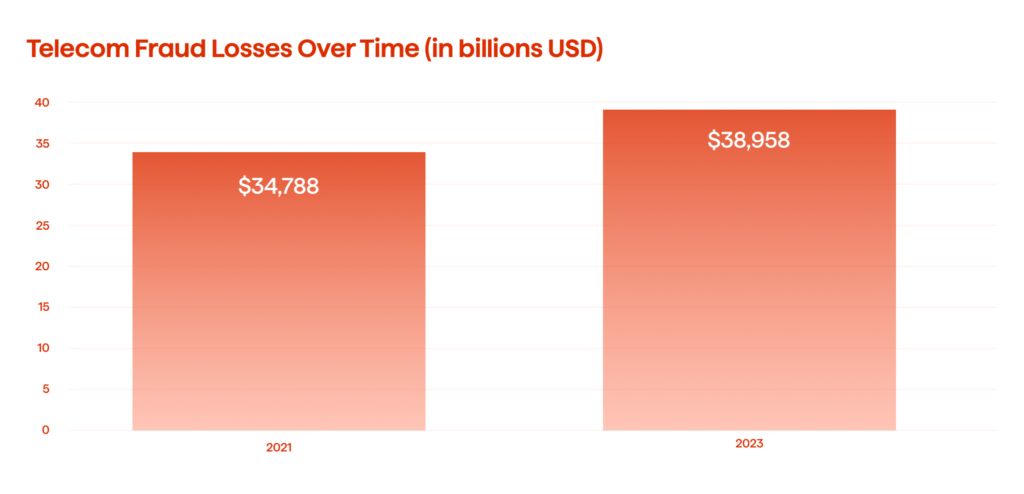
With today’s scale and complexity of fraud, conventional detection systems are increasingly ineffective. Modern fraud management is now driven by Agentic AI for telecom operators alongside GenAI.
Telecom operators process terabytes of granular data — such as Call Detail Records (CDRs), financial logs, and more — in real time. When telcos deploy Agentic AI agents using models like Isolation Forests, One-Class SVMs, RNNs, and Transformers, they can construct rich, detailed behavioral profiles of users.
When anomalies occur — whether through IMEI swaps, IP hops, or implausible geolocations — AI can immediately preempt, predict, and shut down attacks before they escalate.
Furtheremore, AI enables risk-adaptive MFA, which is a game-changer. If a user’s behavior triggers a high-risk alert (we’re talking about unusual login patterns, failed attempts from botnets, disparate IPs), the system recalculates the security needs in real time. Dynamic MFA can employ various methods — KBA, OTPs, biometric verifications – all orchestrated by AI agents, and select the right challenge on the fly based on risk score and contextual parameters.
And what happens when fraud does break through? In such cases, AI can instantly activate a fully autonomous incident-response protocol. It can lock accounts, freeze financial instruments, generate forensic reports, and trigger automated workflows that integrate seamlessly with backend systems. AI also surfaces the complete attack timeline, anomaly scores, and root cause analysis — putting fraud analysts into hyperdrive with precise, actionable data.
In my view, fraud defense is where AI’s speed and pattern-recognition capabilities have always shined brightest. The agents are not just detecting fraud – they can redefine fraud response, shortening detection-to-containment timelines from days to seconds.
Agentic AI in telecom is the future
According to this McKinsey report,, Generative AI has the potential to boost the telecom industry’s revenue by $60-100 billion. A single AI algorithm can handle thousands of customer queries in real time, automate problem-solving, provide service availability updates, and detect fraud — all while reducing operating costs and improving customer satisfaction. The benefits of Agentic AI extend just as far into network optimization and SLA management.
It’s worth noting that realizing these gains are far from trivial. Processing trillions of alarms and aggregating petabytes of network data demands massive storage capacity and thousands of hours of compute power to train and tune models. This scale helps explain why many telcos remain in the early stages of AI implementation. There are significant technical and operational hurdles to overcome alongside the opportunities, and advanced AI Agentic AI adoption will require sustained investment in both infrastructure and talent.
As these capabilities mature, telecom leaders will face a clear choice: remain reactive or become AI-savvy. As someone working at the crossroads of AI and telecom, I believe the next 3 years will separate the AI adopters from the AI-native operators. The forward-thinking organizations will find ways to overcome challenges and embed AI use deeply into their core operations.
FAQ
How AI adoption will shape telecom operations
The winners won’t be the ones who deploy AI tools here and there. They’ll be the ones who build entire intelligent ecosystems – where AI agents are key collaborators, continuously driving performance, trust, and innovation.
If you’re ready to explore what that kind of transformation looks like, reach out to Avenga. Let’s define what AI-powered telecom means for your business — not someday, but starting now.

What are the best practices to make your AI Proof of Concept (PoC) succeed?


Your business results matter
Achieve them with minimized risk through our bespoke innovation capabilities. Fill in the form below.