






Smart fleet management: What to expect in 2026

May 22, 2026 11 min read 235 views
Fleet management refers to managing rising operational costs and disparate data sets while still providing more services per mile driven, a burden that only continues to grow. The 2025 Fleet Technology Trends Report by Verizon Connect finds that 77% of fleet managers identified increasing costs as their primary concern for a record fifth consecutive year. These findings make increasing management efficiency even more important, through integrated platforms for telematics, IoT sensors, predictive analytics, and edge intelligence to track a variety of performance metrics, such as vehicle condition, and to maintain driver and equipment routing, safety, and productivity.
The article aims to help fleet managers and drivers identify technologies and methodologies that provide improved visibility into their operations, with quick response times, cost management, and positive ROI across all operational activities.
Fleet management 2026 key takeaways
- Fleet management is the process by which fleet operators manage all aspects of a fleet, enabling them to run their day-to-day logistics and achieve better control with minimal interruptions.
- Every fleet manager is responsible for fleet safety, route efficiency, and smarter decision-making for vehicle maintenance and dispatch.
- Connected platforms enable fleets to reduce costs by optimizing fleet performance through diagnostics (fewer breakdowns), preventing downtime, and reducing fuel consumption, thereby reducing overall fuel waste across the entire operation.
- Long-term operating efficiency depends on balancing day-to-day operational performance across the entire fleet with longer-term supply chain management decisions, such as vehicle acquisition, fuel usage, maintenance planning, and more strategic management of rising fuel costs.
What is fleet management, and why does it matter for modern fleet operation
Fleet management is the practice of planning, monitoring, and optimizing commercial vehicles, drivers, assets, and workflows throughout a transport operation. A proper fleet management system, at its core, integrates routing, telematics, fuel management, vehicle inspection, safety, and compliance (e.g., hours of service) into a single operational layer rather than separating them across different tools.
This matters more now because the job isn’t just about tracking trucks on a map anymore. Fleet operators are under pressure to cut costs, reduce downtime, handle mixed fleets, and react quickly—without piling on even more fleet management software.
Several shifts define modern fleet approaches:
- Data is now an essential part of how things run. Telematics, diagnostics, and driver stats aren’t just leftover bits of information. Fleets use them every day to plan maintenance, spot trends, and keep costs in check.
- AI’s not stuck on dashboards either. There’s a real split now: some fleets gather info while others let AI find issues, highlight what needs attention, and point them to the next smart move. Tools such as natural-language fleet analytics and AI-powered agents are already being used in everyday operations.
- Running a business means juggling both old and new tech. Legacy devices, older networks, traditional vehicles, EVs, and smart cameras—all of them work side by side. Any modern system has to handle today’s mix while staying ready for whatever comes next.
In other words, fleet management matters because it has become the control system for operational efficiency, risk management, and scale.
Building a fleet management strategy to improve fleet efficiency
Once the operating model is clear, the next step is turning it into a repeatable strategy. Larger fleets are becoming more efficient by focusing on limiting/using fewer individual tools, increasing the use of connected platforms such as GPS tracking devices, camera systems, and incorporating predictive analytics. All of this is being done with a focus on lowering operating costs while increasing their overall return on these investments.
| Step | What to do | What it improves |
|---|---|---|
| 1. Build one operational data layer | Connect telematics, maintenance, routing, fuel, and driver data into one view | Cleaner reporting, faster decisions, stronger asset management |
| 2. Prioritize driver performance | Use coaching, event detection, and scorecards for driver management | Lower risk, better fuel use, more consistent service |
| 3. Move from scheduled to predictive upkeep | Combine service intervals with diagnostics and fault trends for fleet maintenance | Less downtime, better parts planning |
| 4. Optimize movement in real time | Use live vehicle tracking, dispatch logic, and route updates | Higher utilization and better fleet efficiency |
A solid strategy begins with visibility. When dispatch, maintenance, and finance teams use separate data, you end up chasing problems instead of solving what’s actually wrong. One unified platform brings it all together—you can track everything from idling and utilization to compliance and repair cycles in one place. These days, real-time analytics and diagnostics come built into most modern fleet platforms. They’re not fancy add-ons anymore—they’re the norm.
Gain a competitive edge with our transportation and logistics software expertise.
Edge AI for real-time driver assistance and safety
An improvement to a fleet strategy can be achieved with Edge AI, as the solution’s operational aspect runs in real time inside the cab or other parts of the vehicle. Proper fleet managers need to use edge AI for fleet operations by running computer vision and safety models on connected cameras and vehicle hardware, rather than sending every incident to the cloud for processing.
Since fleet managers must identify risky behavior as soon as possible to prevent unwanted outcomes, having Edge AI in operation enables them to act sooner to address such instances.
Examples already on the market are quite specific:
- Samsara AI Dash Cams use AI to detect unsafe driving behaviors (drowsy driving, seatbelt violations, phone use, tailgating, and leaving your lane) and provide real-time alerts and in-cab coaching to help improve.
- Motive AI Dashcam Plus can provide real-time alerts and detect more than 15 unsafe driving behaviors, including lane swerving and unsafe lane changes.
- Netradyne uses edge intelligence and captures all drive time to provide automated coaching through its platform.
For many fleet operators, the benefits are straightforward: improved protection for drivers, cargo, and other fleet assets; safer drivers; and cleaner coaching data.
AI-powered predictive maintenance and vehicle diagnostics
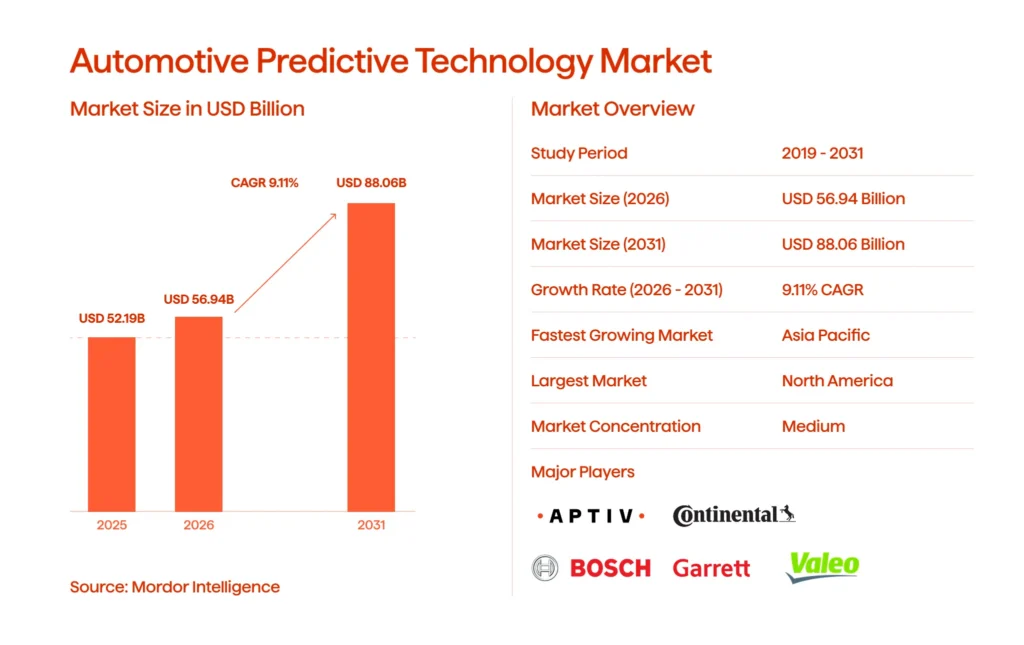
While edge AI enhances the in-transit experience, predictive maintenance is an effective tool that helps prevent disruptions to trips caused by mechanical failure before a trip starts. The automotive predictive technology segment of the marketplace demonstrates this continuum of movement from edge AI to predictive maintenance. Projections for the automotive predictive technology market indicate that it will grow from USD 52.19 billion in 2025 and USD 56.94 billion in 2026 to USD 88.06 billion by 2031, at a CAGR of 9.11%.
Traditional maintenance methods do not adequately support the repair process because they are typically performed either as reactive maintenance or scheduled interval maintenance. Reactive maintenance is done after an incident occurs. Scheduled interval maintenance is performed solely according to a schedule, regardless of whether the vehicle needs servicing. These maintenance processes lead to wasteful costs, unplanned downtime, and poor cost control. All of these problems are further compounded by varying usage patterns throughout the fleet.
In contrast to traditional maintenance practices, predictive maintenance operates differently. This is accomplished through a central platform that accepts inputs such as telematic data, CAN bus data, OBD data, fault codes, historical service records, and various sensors measuring vehicle temperature, battery status, brake wear, vibration, and fuel economy.
Once the input data is recorded, predictive maintenance uses machine-learning algorithms to identify unusual behaviors or patterns, identify signs of wear over time, and detect the presence of multiple sensor systems indicating an impending failure. Geotab defines predictive maintenance as utilizing real-time telematics data and analytics to forecast potential failures before they happen.
5G-enabled route optimization and smarter dispatch
Predictive maintenance enhances vehicle readiness, but 5G technology improves how vehicles operate on the road once they’re dispatched. The most important technical advantages provided by 5G include: very low latency, a large amount of data (or high throughput), and the ability to connect many devices simultaneously. These three advantages will make routing and dispatching vehicles much more responsive than with older mobile technology standards.
5G enables live fleet data (like vehicle locations, engine states, traffic flows, driver actions, road incidents, temperature sensors, camera feeds) processing with near-zero latency, meaning that dispatch systems can review routes, update ETAs, and service assignments based on the actual status of the fleet vs a static plan.
This matters because of the constant flux that fleet managers experience every day from congestion, delivery windows, and breakdowns to weather changes and last-minute requests from customers.
The result is not just speed, but better execution:
- stronger fuel efficiency through less idling and fewer unnecessary miles
- more accurate dispatch decisions
- better use of drivers and assets
- faster response to disruptions
Fleet management companies are beginning to see it as an integral part of their best practices. The purpose of fleet management now extends beyond mere post-factum data visibility to also include improving fleet management decisions as fleet operations occur in real time.
Battery health management and charging logistics for electric fleets
Besides helping a fleet move quickly and promptly in response to dispatch requests with 5G-enabled dispatch capabilities, EV fleets can be better managed through electric operation via energy planning. Uptime for any EV fleet vehicle will depend not only on routing and safety requirements but also on how well a business manages the health of its batteries, the hours during which it has available charging opportunities, and power availability at depot locations and along routes.
Monitoring a battery’s charging level, health (battery pack’s age), temperature, cycle count, and overall wear (based on how worn out it seems) are the initial part of battery life management. These will help determine whether excessive fast charging, deep discharge, and inadequate cooling are negatively affecting the battery’s life, thereby accelerating replacement costs earlier than you anticipated. A strong management system will use telemetry to identify abnormal wear rates, predict how far your battery will go before it can’t be used anymore, and guide charging behaviors that optimize the long-term value of your battery.
Charging logistics is the practical implementation of the equation. It is how fleets match their route plans to their required charging schedule, available boarding time, available charging price points, and grid limitations. Smart сharging logic can:
- shift charging to off-peak hours
- prevent charger bottlenecks
- balance depot power loads
- prioritize vehicles with earlier departures
This does more than lower operating costs. It helps operators track vehicle readiness across the entire vehicle fleet, reduce range-related disruptions, and improve planning accuracy before vehicles leave the depot.
FAQ
Choose your fleet management solutions wisely with Avenga
Fleet management helps with vehicle monitoring and tracking, but it’s not just about that. The role of a fleet manager has evolved since the inception of the connected fleet; it now encompasses using the connected systems to increase uptime, reduce overall fleet costs, and respond to real-time data. To remain competitive in the present environment, a company’s fleet managers must ensure that each operation related to routing, maintenance, and safety works in unison. They also need to improve driver safety, increase visibility into driver behavior, and tighten control over fuel consumption and usage to eliminate fuel waste across the entire operation. What benefits does fleet management software provide?
Want to learn more about the best fleet management solutions? Contact Avenga to know about fleet management in 2026.

What are the best practices to make your AI Proof of Concept (PoC) succeed?
Your business results matter
Achieve them with minimized risk through our bespoke innovation capabilities. Fill in the form below.