





Start a streaming service in 2026: Create an entertainment platform with Avenga

May 20, 2026 11 min read 418 views
Thinking about building your own video streaming platform? There’s a world of difference between tossing together a basic online streaming site and running something like Netflix. The biggest factor is the architecture. You’ll need a solid way to get your content in, encode it fast, and stream it smoothly to viewers everywhere. Security matters, too; you want your library locked down, but you don’t want watching to be a hassle. In this guide, we’ll walk you through the essentials: how to lay your foundation, pick the proper CDN and DRM, and set up monitoring that keeps your platform running strong, even as you grow.
Streaming apps key takeaways
- A streaming platform like Netflix is an entire system of components. From the start, you should create a technical stack for streaming that includes ingest, encoding, storage, CDN, and monitoring.
- As you scale, your CDN and live streaming app server strategy will influence both the successful delivery of content (to viewers) and your overall costs.
- You should also have a monetization plan in place, including whether transactional video on demand makes sense for your content strategy.
- Whether you want to create VOD, live, or both, tailor the platform to your audience and grow features based on real usage data.
Streaming service architecture overview
A successful streaming website that’s ready for real users is a whole network of components working together to deliver video from its source to your screen. The goal? Keep everything running smoothly and make sure only the right people can watch. When establishing an on-demand or live streaming website, typically, you’ll divide your plan into several parts: preparing the content, delivering the content to your audience, managing the service itself, and developing any viewer-facing applications.
You will start by taking your content source (e.g., upload files or live streams) and preparing it for delivery to your viewer’s media player via transcoding and packaging; during this phase you’ll include attributes such as various video (resolution) formats, as well as subtitles and thumbnail and fast start time capabilities, etc.
After that, you’ve got origin storage and the CDN. They’re the ones making sure your videos reach people anywhere, even when everyone’s watching at once. Then comes your product backend: user accounts, subscriptions, entitlements, search and recommendations, and all the APIs your video streaming app needs. Last, you hit the player layer, where it all comes together. That’s your web, mobile, or TV app actually playing the video, handling DRM, and switching bitrates on the fly.
The main premise is that a solution like Netflix works because each layer scales independently. You don’t want billing changes to impair playback, or a live event spike to knock down your catalog service.
| Layer | What it includes | What it enables |
| Content ingest | Upload pipeline, live stream ingest, validation | Brings video into the platform safely |
| Processing | Transcoding, packaging, captions, thumbnails | Multiple qualities and features, like subtitles and previews |
| Storage + origin | Object storage, origin servers, origin shielding | Reliable source of truth for segments and manifests |
| Delivery | CDN, edge caching, geo routing | Fast playback worldwide and spike protection |
| Product services | Auth, catalog, search, recommendations, subscriptions | The business logic behind the streaming website |
| Playback clients | Web/mobile/CTV video streaming application, player SDK | Smooth playback, ABR, DRM, analytics events |
CDN strategy and selection for global streaming business growth
A CDN strategy is basically your playbook for getting video to your viewers. It’s about where you put your servers, how you cache and move traffic around, what you do when things go wrong, and how you track if it’s all working. You’re not just picking a vendor off a list. You’re making real decisions about how your streaming output, those HLS or DASH segments and manifests, get cached, delivered, and kept secure, so your video runs smoothly everywhere you need it to.
Why it’s crucial: a streaming service like Netflix feels instant because most queries never touch the origin. They’re provided by edge caches near the viewer, which minimize startup time, buffering, and costs. Without a carefully planned CDN strategy, your origin becomes the bottleneck, and increasing traffic only worsens the problem.
A strategic approach to a CDN will include:
- Identifying the areas of highest user density and how the CDN will be extended to those regions. This includes coverage and latency planning.
- Creating a cache design that includes things such as keys to use in the cache, how long to keep items in the cache, how to remove items from the cache, and what the design of your segments should be to achieve the highest hit ratio for your streaming protocol.
- Protecting the origin from events that will generate a high amount of traffic, such as a free trial or a viral spike. This protection can be achieved by implementing origin shielding and rate limiting.
- Understanding whether a single CDN or multiple CDNs will work best for redundancy during large digital events or high peak usage during a live video event, will help you make your decision accordingly.
- Security is of the utmost importance; you should use tokenized URLs and/or signed cookies and implement a web application firewall (WAF) to block hotlinking and abuse.
Early-stage teams often choose to partner with a single major vendor, such as Google (or another hyper-scale CDN), to expand their global network presence quickly; whereas high-scale venues tend to use multiple CDNs as a way of reducing risk during live events; other teams that are building their own streaming rush will do so for cost control or latency reasons, primarily focused on their core market(s).
Monitoring proxy metrics, including cache hit rate, time-to-first-frame, rebuffering rate, and origin egress, helps you determine whether your CDN is facilitating or hindering the growth of your online video streaming business.
Let’s team up to redefine the future of media by building your perfect platform and unlocking new revenue streams with our custom software and tailored services.
App and platform layer: web, mobile, CTV, and player considerations
A streaming solution is what turns your video content into a saleable product in the streaming market. It’s also where your customers’ expectations diverge. For example, web users can tolerate occasional, brief refreshes, while living room consumers on set-top box platforms expect “press play, it plays”. Therefore, video streaming application development is not simply about one application shipping to multiple environments. Each client must also adapt to its device-specific constraints, input methods, and possibly variable network conditions.
On the web, it’s all about getting things up and running quickly, ensuring everything works across browsers, and keeping the video player clean and straightforward. You’ll wrestle with browser DRM, figure out adaptive bitrate streaming, and set up solid fallbacks for missing codecs. Switch over to mobile, and suddenly bandwidth swings and battery life jump to the top of your list.
Live streaming services that best serve customers will intelligently deliver content at the right time or may have the capability for the customer to continue watching where they stopped. CTVs and set-top boxes are a different story. In those cases, your player’s performance should be priority #1. You’re working with limited memory, slower processors, and unpredictable OS updates, so you’ll want to streamline the player, keep the UI lightweight, and test extensively on every device you plan to support.
Do not wait until later: incorporate observability into your video streaming service from day one. Instrument measures such as time-to-first-frame, rebuffering rate, bit rate distribution, video player errors, and every single DRM/license failure according to device model; these metrics will indicate if your video streaming service has a premium or frustrating overall video streaming experience; these metrics also will indicate whether video streaming problems are related to the app, the content delivery network (CDN), or the encoding hierarchy.
DRM implementation and content protection
Digital Rights Management, or DRM for short, refers to the technologies used to control who can view your content, on which devices, and under what conditions. It is DRM that makes sure that anything streamed on demand through an online video platform or video streaming website won’t be “downloaded once then re-uploaded everywhere.” This is a significant concern because piracy is a massive business; one major illegal live sporting event network received approximately 1.6B visits in one year before it was taken offline. Additionally, security costs associated with security failures (even when piracy is not involved) are incredibly high, as evidenced by the average price of $4.88M per data breach globally.
In practice, you encrypt video chunks, which are subsequently only decrypted by licensed players who have obtained a license from your DRM provider.
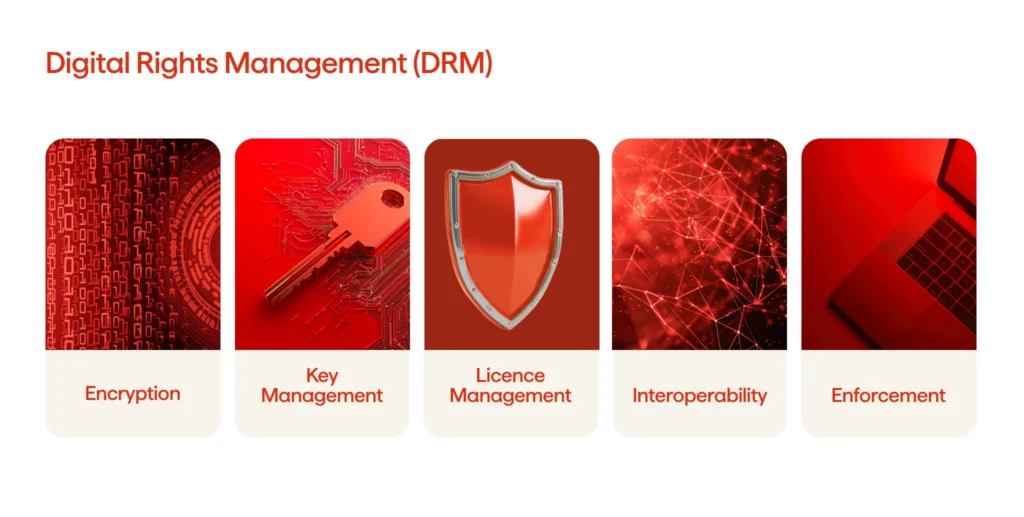
The following are the key elements:
- Encryption. The packager encrypts the segments (HLS/DASH), so if they are copied, the data will be useless because there is no way to decrypt them.
- Key management. Generate, rotate, and securely store encryption keys.
- License management. The license server will provide licenses that expire (self-destruct) for a limited time after verifying that the user is entitled to play the content.
- Enforcement. The security module on the player and/or device will enforce all rules (expiry date, offline use, output protection).
- Interoperability. Must support all of the major DRM ecosystems (so that you can build an ecosystem that works on Web, mobile, and TV).
When you create a new streaming business, you need to implement DRM as part of the overall streaming software solution (along with playback and identity). Your streaming business depends on this in the same way the CDN depends on you, especially as content becomes “shareable” like a playlist.
Analytics and monitoring systems for QoE and reliability
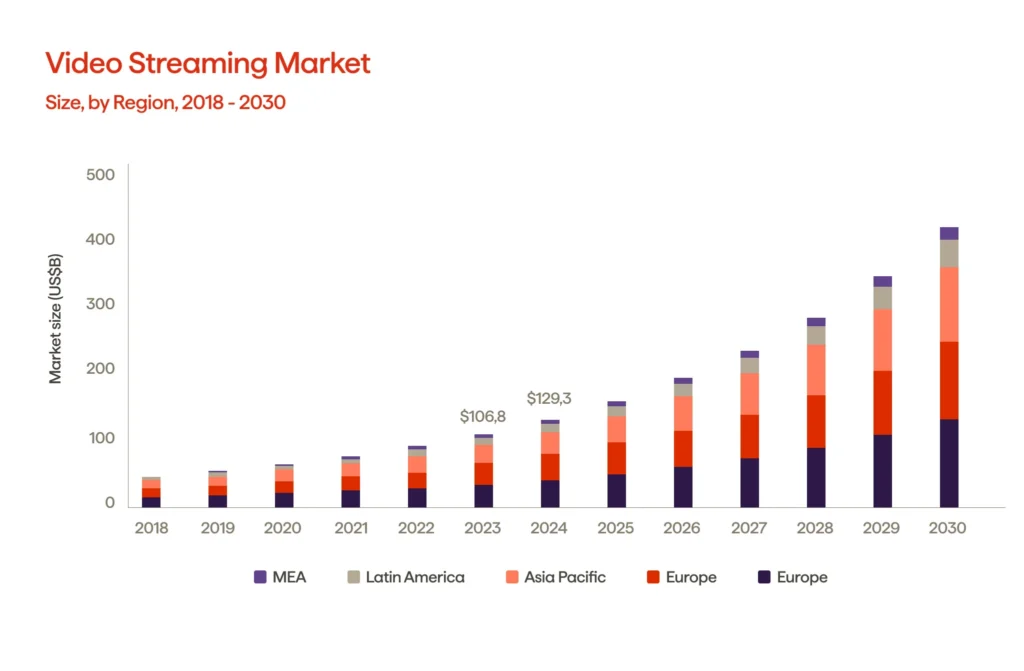
Streaming content is one of the simplest functions within the overall online video experience. However, the moment you need to stream video reliably across devices, geographies, and traffic spikes, architecture becomes critical. According to Grand View Research, the global video streaming market is projected to reach US$416.84 billion by 2030. Hence, establishing performance and consistency as part of your product strategy is essential to your streaming services business, given the need to retain customers.
For on-demand streaming, most platforms use HTTP-compatible formats (HLS/DASH) because they perform well across CDNs and enable efficient adaptive streaming. As your live streaming platform “pulls” segments through existing web infrastructure, you can build your online (web/mobile) and CTV platforms faster than with other forms of distribution.
Typically, there is a separation between ingesting media and delivering that content in a live environment. Many streaming workflows use RTMP to send video from the source to an encoder (or a live streaming platform). After encoding, the provider packages the output into playback formats such as HLS or DASH, which viewers then use to watch the stream. In addition, WebRTC is an extremely widely used real-time streaming protocol for creating interactivity, with typical round-trip times of under 500 milliseconds.
This stack enables you to deliver a reliable experience in video streaming app development while scaling globally.
FAQ
Building a secure platform that scales
Creating a streaming service might be a lucrative initiative in 2026, but only if you do it the smart way. Don’t expect to start a live video streaming platform and gain instant recognition. Instead, focus on nailing the fundamentals first: a reliable streaming server setup, the right CDN and DRM choices, and a clear path to content, distribution, and monetization that can scale as your audience grows.
If you want to learn more about building your own streaming service, contact Avenga, your trusted streaming infrastructure partner.


Salesforce for healthcare: Health Cloud use cases and implementation

Your business results matter
Achieve them with minimized risk through our bespoke innovation capabilities. Fill in the form below.