



Digital transformation in the energy sector: 2026 guide


February 23, 2026 11 min read
With increasing demand for electricity, the European Commission estimates that by 2030, demand will be around 60% above current levels. The growth in demand comes as the European Union commits to developing its wind and solar resources to achieve 1,000 GW by 2030 and 317 GW of offshore renewable energy systems by 2050. That means rapid expansion and upgrades to power grids.
Energy companies must elevate their technology landscape to succeed. This happens through digital transformation in energy businesses, which isn’t simply about aggregating more data; it’s about leveraging that data to improve decision-making, reliability, and reduce friction in the operation of clean energy. If you have access to the right digital tools and modern energy management practices, and you implement a roadmap that delivers primary value, resilience, and compliance from the start, you will achieve a competitive advantage. This guide for energy companies aiming to enhance their operations explores how digital transformation is reshaping the energy solutions market.
Energy digitalization key takeaways
- The new operational advantage is energy data. Grid events are translated into decisions via a trusted, shared data layer, which enhances forecasting, reliability, and the benefits of digital across the power system.
- Orchestration is necessary for the energy transition, not only resources. To stabilize energy production and minimize curtailment, DERs, storage, and demand flexibility must cooperate.
- Risk is decreased with real-time energy capability. To minimize congestion, avoid outages, and respond to volatility when circumstances change, faster visibility and automated control are essential.
- Businesses that aggressively use digital scales are more successful. Pilots are transformed into repeatable value by robust platforms, security, and product teams, setting the standard for the energy and utilities industry’s future.
The energy sector digitalization: an overview
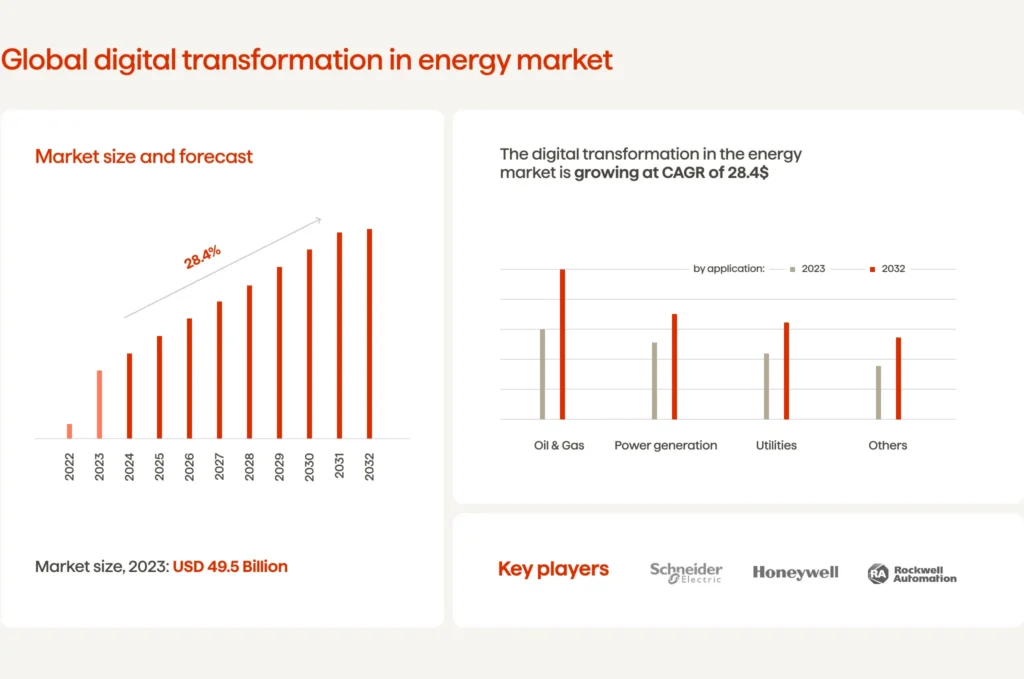
Digital disruption happens in the energy business as the stakes get higher. Energy demand is growing; everyone wants the lights to stay on all the time, and renewable energy sources are becoming more accessible than ever. The increase in investment makes sense. One industry estimate puts the digital transformation of the energy sector at about $49.5 billion by 2023. Additionally, growth will continue through 2032 at an annual rate of almost 28.4%. The big drivers? Companies want greater efficiency, better ways to integrate renewables, a more robust grid, and smarter, sustainable energy assets built on real data.
When people talk about “digitalization,” they’re really talking about shifting from checking in every so often to actually keeping an eye on things all the time. With sensors, edge analytics, and cloud data, smart grids can now monitor energy distribution almost instantly, spot problems right away, and adjust operations to ensure we’re not wasting power. This digital layer does a lot for renewables, too. Wind and solar output get tracked, fine-tuned, and even predicted using digital initiatives. Storage? It’s no longer just sitting there on its own. It’s part of a flexible system that’s much easier to manage.
This shifts how we think about assets. With predictive maintenance and asset performance management, you use real-time data to spot problems before they happen, focus on what really needs attention, and keep things running smoothly. Maintenance stops being about following a schedule and starts being about actual equipment conditions.
The real glue here is flexibility. Digitalization makes it possible to pull everything together, including demand response, EV charging, solar, storage, forecasting, and run it as one coordinated system. It’s a big step forward, not just for reliability and cost savings on the grid, but for rolling out new digital tools like customer apps, flexibility programs, and ways to manage distributed energy resources.
We offer full-cycle automation services, covering design, implementation, and management.
Building the digital foundation to optimize energy
If you want to get serious about “optimizing energy,” you have to lay the groundwork before you bring in any fancy AI or dashboards. The real work starts with building a solid foundation that actually sticks inside your operations, customer touchpoints, and business areas like energy trading. Skip this part, and things fall apart fast. You get a mess of disconnected pilots, numbers that never match up, and endless debates about whose data is “right.”
Here’s what matters: take all those scattered systems, including operations and enterprise, and turn them into one clear, reliable view that shows you what’s happening with your grid, your assets, and your customers. And don’t just collect information; make it something you can actually use to make decisions, right when you need to. You need to connect OT and IT safely, standardize your data, and set up integrations so new digital energy tools can fit right in, without months of headaches. Plus, you have to build for speed and toughness. The grid doesn’t pause for overnight data updates, and today’s grid management needs constant, real-time visibility.
A practical foundation usually comes down to a few building blocks:
| Foundation block | What it enables | Why it matters for utilities |
| Unified data layer (OT + IT) | Consistent data for operations and analytics | Fewer “multiple versions of truth” across the grid and business teams |
| Real-time integration (APIs + event streaming) | Faster workflows and automation | Supports real-time grid actions and near real-time customer insights |
| Interoperability standards | Easier vendor/system connectivity | Reduces integration cost and speeds scaling of digital solutions |
| Security-by-design | Safe IT/OT connectivity | Critical for resilient grid management and regulatory expectations |
| Product operating model | Repeatable delivery and ownership | Turns pilots into scalable capabilities, not one-off projects |
| Observability and data quality controls | Reliable metrics and debugging | Keeps trading, forecasting, and operational decisions trustworthy |
When these components are built first, everything else, including DER orchestration, predictive maintenance, flexibility programs, and even more intelligent peer-to-peer energy trading, becomes easier to scale and more quickly delivered.
Grid modernization and decentralized energy resources (DERs)
The old energy grid worked in one direction. Large power plants produced electricity, consumers utilized it, and operators oversaw everything from the top down. However, when you include household batteries, EV chargers, microgrids, and rooftop solar panels, that configuration breaks down. Digital power is suddenly moving in both directions and constantly changing, sometimes even within a single neighborhood.
So now, energy providers need more than new wires and transformers. They have to upgrade the grid with better data and more innovative technology. Real-time monitoring is enabled for operators by tools such as edge devices, smart meters, and sophisticated sensors. All of that information is combined by digital systems, which then use it to estimate demand, manage traffic, optimize voltage, and coordinate all of the dispersed energy resources. If you get it right, the grid will adjust. This implies that we won’t have to worry about the lights turning out when we add more renewable energy sources.
DERs open up new ways to boost energy efficiency. Operators can now influence peak demand rather than merely accept it. With managed charging, demand response, and time-based incentives, they guide how and when people use energy. A lot of this happens through apps, online portals, or automated programs that customers use every day. In the end, the grid handles renewables better, reduces wasted energy, and keeps costs in check. Plus, customers get to be part of keeping the whole system steady.
Predictive maintenance and asset performance management
For energy utilities, everything comes down to their assets: transformers, turbines, substations, lines, breakers. These are what really decide how reliable and affordable the service is, way more than any fancy software. That’s why predictive maintenance is quietly changing how the whole industry works. Instead of just sticking to a calendar or scrambling when something breaks, teams now watch for signs of trouble and jump in before things go sideways.
This is the point at which digital innovation becomes meaningful. There are sensors everywhere, SCADA and IoT data flowing in, thermal cameras identifying hot areas, drones taking inspection photographs, and all the old maintenance records mixed in. All of this data is fed into asset health models, which aid in forecasting an asset’s likelihood of failure and remaining life. Suddenly, operators know where to focus. Which part is most likely to knock out the grid? Which fix keeps a minor problem from turning into a nightmare? And what can wait without causing chaos? That’s the new way to keep the lights on.
It goes beyond simply avoiding surprises. In fact, implementing digital technologies can reduce operating expenses by lowering unnecessary truck trips, last-minute repairs, and equipment downtime, and by enabling more intelligent spare-parts planning. Because there is less hurried, dangerous fieldwork, safety also improves. Additionally, you have strong evidence of your assets’ condition and the steps you’ve taken to maintain operations in the event authorities arrive.
If you stick with this strategy, the entire game will start to shift. Utilities start to resemble data-driven reliability teams. Thoughtful, risk-based planning that directly relates to how successfully you keep the lights on replaces last-minute panic in maintenance. In summary, global energy distribution becomes more challenging and dependable, freeing up funds for grid improvements and the integration of renewable energy sources.
AI-driven demand-side flexibility and virtual power plants
The energy sector isn’t what it used to be. With renewables shaking things up, EVs pulling more power, and reserve margins getting thinner, flexibility is essential. That’s where AI steps in. It predicts what you can move around, determines the best time to do so, and keeps everything running smoothly without messing with comfort or day-to-day operations. For teams driving digital transformation, flexibility isn’t just a buzzword. It’s a test. Data platforms, automation, cybersecurity, and customer experience all have to click together for it to work.
The benefits of digital in AI-powered demand-side flexibility:
- it identifies “shiftable” load windows and forecasts short-term demand.
- it maintains user preferences while automating processes related to industrial loads, HVAC, and EV charging.
- it gives consumers control over their energy instead of generic alerts, increasing participation through improved targeting and incentives.
- it powers customer-facing digital solutions (portals/apps) that provide transparent scheduling, opt-in, and rewards.
What distinguishes a virtual power plant (VPP):
- combines a variety of dispersed assets such as batteries, solar power, flexible loads, and electric vehicles into a single, manageable fleet.
- uses AI to accurately predict dispatch and availability even in the face of changing circumstances.
- generates verified system services, such as balancing, congestion relief, and peak support, allowing utilities to consider the fleet as a reliable resource.
In summary, if energy firms wish to include additional renewables without compromising dependability, they must develop flexibility as a product and an operational capacity, not a pilot.
FAQ
Future energy industry: turning complexity into a digital edge
The energy sector faces a once-in-a-generation challenge: rising energy consumption, higher reliability expectations, and a faster transition to renewable energy sources, all happening in an increasingly global digital power utility market. The winners will treat this as a structured transformation journey, building strong data foundations, modernizing grids for DERs, and using AI in energy where it creates measurable operational leverage. That includes the ability to predict energy demand and asset risk, orchestrate flexibility through VPPs, and run the system with tighter control and fewer surprises.
In an evolving energy landscape, utilities and energy companies that actively implement digital capabilities will be best positioned to improve reliability, optimize costs, and accelerate the energy transition. Want to learn more about the future of energy digital products? Contact Avenga, your trusted leader in energy flow and digital transformation strategies.



Telecom industry trends 2026: Prepare for the future
Your business results matter
Achieve them with minimized risk through our bespoke innovation capabilities. Fill in the form below.