



Telco cloud 101: Why cloud computing will become imperative in telecom of 2026


February 24, 2026 10 min read
Telecoms are at a crossroads. With accelerating data flow, growing customer expectations, and disruption by the new digital economy, the traditional network model is crumbling. According to a report released by Capgemini in February 2023, nearly half of the telecom industry (46%) is expected to transition to a cloud-based model within the next three to five years. With more than 800 global telecom companies competing, this type of transition will require substantial investment, averaging $200 million per year per company.
This is not just a shift in workload; telco cloud architecture is the new foundation for operating network functions across private cloud and edge computing environments. Telecoms that modernise now will have the ability to scale, automate operations, and support next-generation services quickly. Those who wait will miss the boat as the industry undergoes a complete re-architecting process for evolution in 2026 and beyond.
Key takeaways: what telco cloud means for 5G and beyond
- The power of the cloud enables organizations to grow faster by utilizing less capital and avoiding the need to modify their existing physical infrastructure when developing the next generation of solutions.
- A key component of developing modern telco cloud infrastructure is having a cloud-native architecture, which enables the flexible deployment of network operations and the rapid development of new products, services, or solutions.
- When coupled with efficient governance, cloud-based consumer data management improves analytics, personalization, and security.
- Building a telco cloud allows operators to enhance network connectivity, positioning them well for the 5G rollout and beyond.
The demands of 5G networks on cloud infrastructure
5G is changing the future of how telecommunication networks are created and run. Due to the ultra-low latency and the incredible number of connected devices (the IoT), as well as the necessity to process data in real-time, communication service providers (CSPs) are being burdened with requirements that cannot be supported by the current (legacy) infrastructure. As a result, the cloud platform has evolved from an optional tool to a necessity; it is now required to be used in conjunction with CSPs’ ability to provide scalable, secure, and monetizable 5G services.
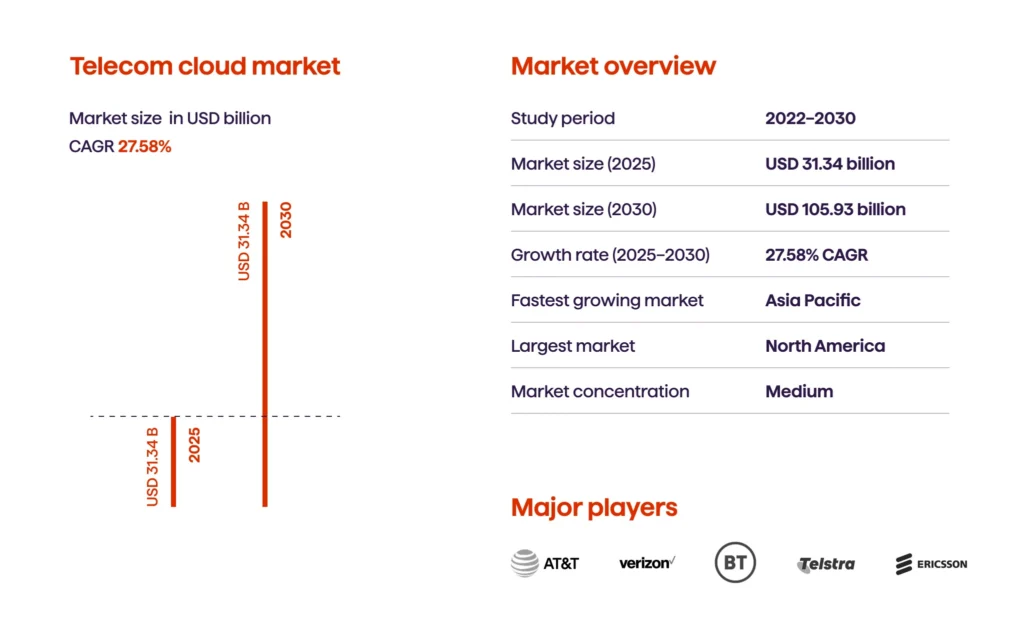
Shifting market signals support this transition. In the telecom cloud market segment, total industry revenue is expected to reach $105.93 billion by 2030, growing at a compound annual growth rate (CAGR) of 27.58%, and surpass $31.34 billion by 2025. Cloud-native core networks and edge computing, network slicing, and automation will be at the forefront of prioritization for operators. Examples of how telecom cloud solutions have become an integral part, rather than a supplement, to 5G strategies are diverse. AT&T’s investment of $14 billion in the open RAN agreement with Ericsson, and Vodafone’s partnership with Microsoft for $1.5 billion in the 5G space.
This shift imposes additional service expectations and requirements for Data Centers and Micro Data Centers located on the Edge. The multi- or hybrid cloud service model must maintain an equal focus on delivering high-performance systems while also meeting the requirements of legal jurisdictions and regulatory compliance, as well as protecting the integrity of the underlying network’s infrastructure. Having tools in place that can automatically respond quickly to potential problems is essential for achieving these goals, given the increased volume of traffic caused by 5G Wireless services.
Why traditional telco infrastructure can’t keep up
Telecoms have traditionally launched their services using static infrastructure, which means there is only one centralisation point for every service. As telecoms transition to 5G, real-time services and edge-driven applications, the traditional telecom infrastructure model is no longer sufficient. The industry has made considerable efforts to develop new digital services rapidly; however, existing legacy stacks struggle to expand, adapt, or connect to today’s digital services and modern cloud computing capabilities.
The limitations of legacy telecommunications infrastructures:
- Legacy telecommunications infrastructure is built on rigid hardware, making it impossible to deploy new applications and network functions rapidly.
- Legacy telecommunications infrastructure incurs high capital expenditures (CAPEX) and long upgrade cycles. As a result, operators using old-fashioned infrastructure can’t innovate quickly or as efficiently as agile cloud-based providers.
- The lack of support for automation and orchestration creates additional operational complexity for companies using legacy infrastructure.
- The way legacy infrastructure was designed does not align with the development of edge computing and the public cloud domain.
- It’s challenging to integrate modern cloud services for telecom, such as AI-driven network management
The physical infrastructure that underpins today’s telecommunications networks must be replaced by future-proof technology.
Transform your legacy OSS and BSS platforms into modern, future-ready systems.
Impact of cloud computing explained: from virtualization to cloud-native
The development of telco cloud computing has progressed significantly beyond virtualization. Initially, telco companies were involved in transforming their network using network function virtualization (NFV). Then they transitioned from providing dedicated physical appliances for the core networks to implementing virtual machines (VMs). While this enabled these operators to reduce costs and improve flexibility, it also maintained many of the complexities associated with traditional physical infrastructure.
The evolution of cloud-native architecture has evolved. This has created microservices out of network functions, which are run in containerized environments and orchestrated by platforms such as Kubernetes. Instead of deploying, scaling, and updating networked services from a monolithic network system, telco operators can now deploy, scale, and update networked services independently.
At the same time, leading cloud technology vendors like Google Cloud are now providing platforms that support distributed cores, edge deployments, and real-time processing of customers’ data, thereby allowing operators to put their workloads closer to their customers and manage cloud data securely while also responding rapidly to market fluctuations or demand without losing reliability.
Benefits of cloud-native services for telecom operators
- Without incurring significant investments in new infrastructure, telcos can utilize elastic scalability to increase network resources as needed, enabling operators to maintain high service levels during periods of peak traffic.
- The deployment and update cycles of network functions and applications are greatly accelerated by cloud-native architectures, which shorten the time it takes to launch new services.
- By mitigating the effects of outages and reducing their duration, automated failover solutions enhance a network’s resilience and facilitate faster restoration through dispersed deployment options, self-healing workloads, and automatic failover capabilities.
- Sharing cloud infrastructure reduces reliance on hardware and makes it easier to operate and maintain ongoing hardware.
- With centralized controls and encrypted data, as well as continuous monitoring of cloud activity, organizations can maintain the security of their customers’ data while remaining compliant with various regulatory standards.
Telco cloud and network automation in practice
The primary benefit of network automation for telecommunications companies (telcos) is the ability to realize operational efficiencies through cloud adoption. Cloud-native technology enables telcos to provision, scale, and self-heal their networks (i.e., add/remove physical and virtual devices) automatically, without the need for human intervention. That is, if there is a spike in demand at an edge location due to increased traffic to/from that site, the telco can enable the automatic allocation of compute resources to that area without ever having to connect with an employee.
The majority of telco operators have developed integrated or unified architectures that leverage telco/circuit infrastructure cloud service offerings from various sources, including public cloud providers, private cloud infrastructure, and edge nodes. When built on a public cloud basis, for example, by Google, this type of integrated architecture will provide telco operators with predictive/real-time capabilities based on machine learning analytics. This will allow telcos to anticipate potential limitations (for example, clogged networks), enhance routing, and resolve issues before customer service is impacted. By automating and leveraging a combination of data and technology in this manner, telco operators can minimize total operational costs while maintaining the same level of service.
By utilizing intelligent automation when deploying telco/circuit infrastructure cloud services, telecom operators will now have an adaptable platform to deliver 5G and enhanced service offerings today, as well as into the future, while providing a reliable and consistent high level of customer service.
Cybersecurity in the telco cloud: A non-negotiable priority
As telecom operators migrate to cloud-native architectures, the attack surface expands significantly, and so do the stakes. Telcos handle vast volumes of sensitive subscriber data, critical national infrastructure, and real-time communications, making them prime targets for sophisticated threats. According to Nokia’s Threat Intelligence Report 2024, telecom networks saw a 42% increase in DDoS attacks compared to the previous year, with IoT botnets accounting for the majority of malicious traffic.
Cloud-native security in telco environments goes beyond traditional perimeter defense. The shift toward microservices, containers, and multi-cloud deployments demands a zero-trust security model, where no user, device, or network segment is trusted by default. This means continuous identity verification, end-to-end encryption, and real-time threat detection across every layer of the stack. The GSMA’s Telco Security Guidelines and ETSI’s NFV security frameworks provide operators with structured approaches to securing virtualized and cloud-native network functions.
The good news: cloud-native tooling, when properly implemented, strengthens security posture. Centralized policy enforcement, automated patch management, and AI-driven anomaly detection give operators capabilities that legacy infrastructure simply cannot match.
FAQ
Final words: cloud infrastructure as the foundation of the telecom future
Cloud-native networks will help industry leaders enhance their telecom software in 2026. How? The role of cloud computing is hard to overestimate, as it provides better means to manage and scale operations. The trend toward using cloud capabilities for telecom has evolved from a “test/investigation” phase into a fundamental building block of next-generation networks, enabling faster innovation, greater resiliency, and improved data utilization. Want to improve service levels and competitive pricing? Cloud telecom is your best friend.
Want to learn more about how to use the cloud to accelerate your services and improve operations? Contact Avenga, your trusted telecom network partner.

Telecom industry trends 2026: Prepare for the future

Telecom billing software systems: A comprehensive guide

Telecom self-reported 101: adopting self-service credit reports
Your business results matter
Achieve them with minimized risk through our bespoke innovation capabilities. Fill in the form below.