





Shaping the future of streaming services and platforms: How content delivery evolves

June 18, 2026 8 min read 315 views
Follow the money — it’s playing on your TV right now. The video streaming market is valued at over $670 billion and is expected to reach $2.49 trillion by 2032, growing at a projected CAGR of 17.8%. Netflix may have written the first playbook, but the next chapter will feature innovative packaging, smart bundling to reduce choice overload, and ad-supported pricing models that lower costs without compromising the viewer’s experience.
For subscribers, the future offers seamless access — single sign-in, unified profiles, and personalized recommendations that travel with you. Behind the scenes, streaming software services are powering this transition — with workflow tools for both live and VOD, shoppable overlays, identity synchronization, and next-generation server-side ad insertion that makes personalization feel seamless.
This article outlines where the stream is heading: aggregation as a core product feature, interactive formats that truly engage audiences, and technology choices that turn watch time into sustainable revenue — without turning the screen into a billboard.
The many ways a streaming service changes
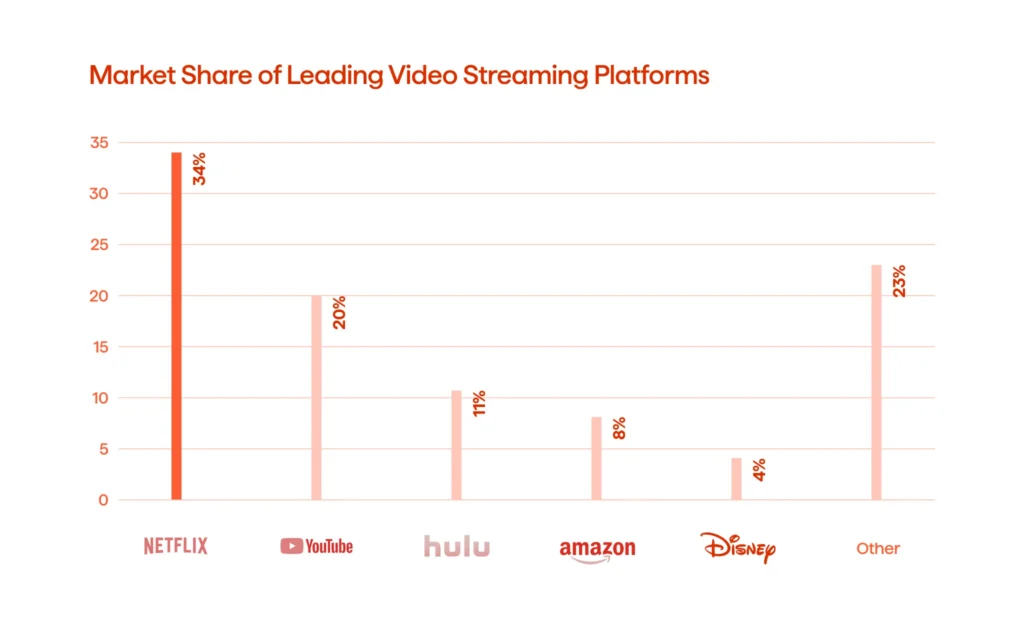
The chart below says a lot about the streaming landscape: Netflix holds roughly 34%, YouTube about 20%, Hulu, Amazon, and Disney+ each in the single digits — and “Other” with a surprisingly large 23%. That last bar is incredibly revealing. It represents a fragmented market, where the long tail, comprising niche apps, regional players, and FAST channels, represents almost a 1/4 of consumption. The future of streaming isn’t shaping up to be a winner-takes-all scenario; it’s an orchestration challenge — helping people navigate abundance without friction.
In this future of streaming, the best platforms will feel instantly familiar — combining the simplicity of traditional TV (click in, something good is on) with the control audiences expect from on-demand viewing. We anticipate hybrid value stacks, such as subscriptions paired with ad-light tiers and free linear channels, allowing households to mix streaming options that suit their budgets and viewing habits. Aggregation will also become a defining feature: one login, one bill, universal search, and profiles that move seamlessly across apps — removing the extra steps between turning on the TV and watching something you love.
Live programming helps define weekly habits — sports, events, local news — while interactive features such as alternative feeds, live polling, and pause-to-buy opportunities add meaningful action to the viewing experience. Behind the player, advanced personalization powered by Artificial Intelligence tailors content to the viewer’s mood and intent, moving beyond the generic “because you watched.” Meanwhile, delivery technologies like next-gen codecs, low-latency live streaming, and multi-CDN architectures ensure smooth, low-lag playback on every device.
All together, a modern streaming service evolves by reducing decision fatigue and enhancing perceived value — so viewers spend less time browsing and more time fully engaged.
Explore how we created an advertising Platform for JasperLabs and helped them increase campaign engagement four-fold.
Ads that feel like content with hybrid tiers
Hybrid tiers combine the best of both worlds, the simplicity and sponsorship model of traditional cable with the precision and control of modern digital media. The goal is to limit ad volume, make creative placements contextually relevant to the viewing moment, and let users trade time for a lower bill. This approach keeps price-sensitive households engaged and reduces churn without sacrificing value.
A prime example is Hulu’s “Pause ad.” When viewers pause content, a static, unintrusive creative appears as part of the interface — no interruption, no audio spike, just a branded panel that feels like part of the set. This works because the ad meets the viewer during a natural pause rather than competing with the story. Sponsors often tailor their messages to the show’s context — a recipe during a cooking series or fitness gear during a wellness show — making the placement feel more like a helpful addition than an intrusion.
Expect to see even more versions of “ads-as-UI” — interactive overlays during key highlights, sponsors appearing in recaps, and QR code offers that save to mobile without interrupting the stream. Pricing tiers will continue to ladder up — ad-supported, ad-light, ad-free — as households increasingly favor comfort over cancellation. Bundling with telecom providers will also expand: one bill, discounted ad tiers, and zero setup friction. Advertising will feel less like a tax on the product and more like part of the experience.
Prime Video as a hub for channels and single-bill simplicity
Prime Video is evolving from a standalone streaming service into an aggregation hub that resembles cable, without the installer. By 2025, you’ll be able to start in one app, search once, and add premium Channels like Paramount+, STARZ, and MGM+ with a single tap. Billing rolls into your Amazon account, profiles and watchlists transition automatically, and there’s no juggling passwords or payment renewals. Viewers get one front door with a growing schedule of movies and TV shows, while networks gain customers with minimal friction, no need to rebuild the checkout flow.
The strategy works because Prime anchors the bundle with sticky original content — Reacher, The Boys, Thursday Night Football — and lets partner services expand the catalog through unified discovery, search, and recommendations across Channel libraries. For instance, a viewer who finishes a Prime thriller might see a Paramount docuseries suggested next, subscribe in-line, and continue watching without ever leaving the app. That continuity of longer sessions reduces churn for everyone.
It also mirrors the current economics of the streaming industry: a hybrid of SVOD, AVOD, and add-on models where the aggregator wins on convenience, and partners win on reach. In short, Prime Video’s “Channels + single bill” approach turns fragmentation into a feature, bringing the bundle back on streaming’s terms.
The next wave of streaming will run on agents. See how Avenga builds Agentic AI.
Live, shoppable, and personal streams you steer
Live programming is gradually rebuilding weekly viewing habits in ways on-demand never could. YouTube’s NFL Sunday Ticket multiview and Prime Video’s Thursday Night Football with X-Ray stats have turned major games back into appointment viewing — just like the cable era once did, but now with richer data and cleaner interfaces. When viewers know something is on at a set time, session length increases and churn decreases. That’s why sports lineups and tentpole events remain some of the most effective retention drivers. Between those anchors, midweek creator premieres and concert drops fill out the calendar with a steady flow of new content, keeping engagement high without feeling like filler.
Commerce succeeds when it builds on curiosity rather than interrupting it. Shoppable overlays on Roku, pause-to-buy prompts for props or merch, and QR offers that pass carts directly to mobile devices allow a cooking show to stock your pantry or a fashion stream to capture “looks” — all while the story continues to play. That’s incremental revenue for streaming platforms without bouncing users out of the experience, and it scales easily across different services with consistent UX.
Personalization is also becoming more nuanced. Instead of blunt “because you watched…” logic, recommendations now nod toward intent and mood, short vs. deep, learn vs. relax, family vs. individual, and offer controls that viewers can see and adjust. Netflix’s Play Something, scene-level previews, and spoiler-safe trailers all hint at where this next-level streaming technology is heading: navigation you can steer. Combine that with aggregation hubs like Prime Video Channels, Apple TV, and smart-TV home screens, and the experience starts to feel like one connected living room, where original content provides the reason to stay.
FAQ
The future is effortless and instant
The next wave of streaming will feel effortless, one login, hybrid tiers, and live moments, all powered by smarter aggregation and deeper personalization. Future trends point to major streaming platforms partnering with telecom providers for unified identity, billing, and bundles that move seamlessly from screen to screen, reducing churn while expanding reach to new audiences. Shoppable integrations, CTV ads, and modern licensing models will unlock new revenue from watch time, without interrupting the story.
The winners will combine can’t-miss originals with seamless discovery, allowing viewers to watch and engage instead of endlessly browsing for something to watch.
Want to learn more about the future of streaming from a trusted media software development company? Contact Avenga, your reliable tech partner.



Your business results matter
Achieve them with minimized risk through our bespoke innovation capabilities. Fill in the form below.