






Betting on better: Responsible gaming, responsible gambling, and how to gamble without losing the plot


February 12, 2026 11 min read 821 views
People gamble for fun, but modern products can turn “just a quick bet” into a long night. And a long night into a pattern. That is exactly why our experts at Avenga take the problem seriously and puts responsible gambling practices at the forefront of our iGaming solutions.
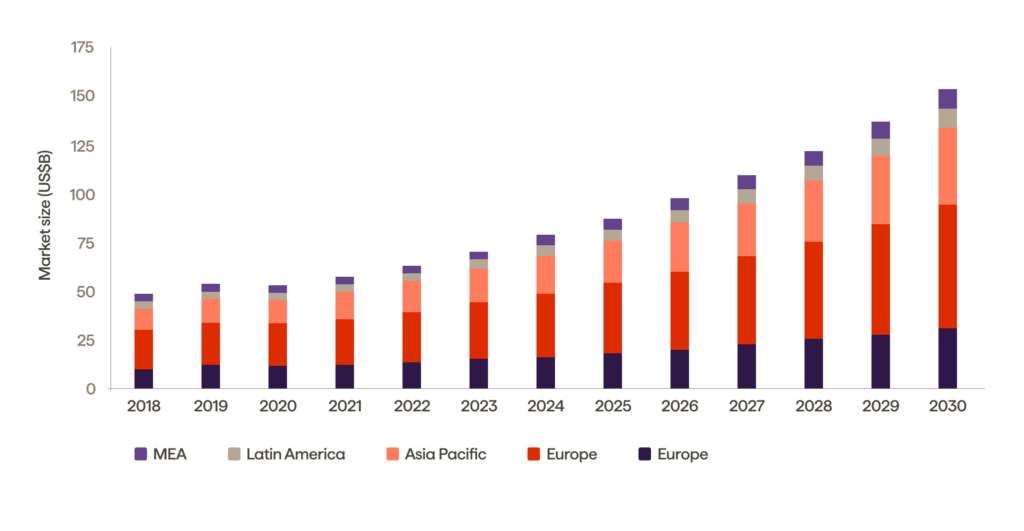
The market keeps growing, too: Statista estimates casinos will generate about $655B in 2026, and it projects 12.8% global user penetration for online casino games in 2026, with an ARPU of around $653. In turn, Grand View Research puts online gambling alone in the ballpark of $153 billion by 2030 (see Fig. 1).
This guide cuts through the noise. You will learn:
- what responsible play looks like in practice;
- which responsible gambling tools actually help;
- how operators can reduce harm without turning the product into a lecture;
- what to do if someone you know might need help;
and much more. Stay tuned!
Gamble-proof your fun: What does responsible really mean?
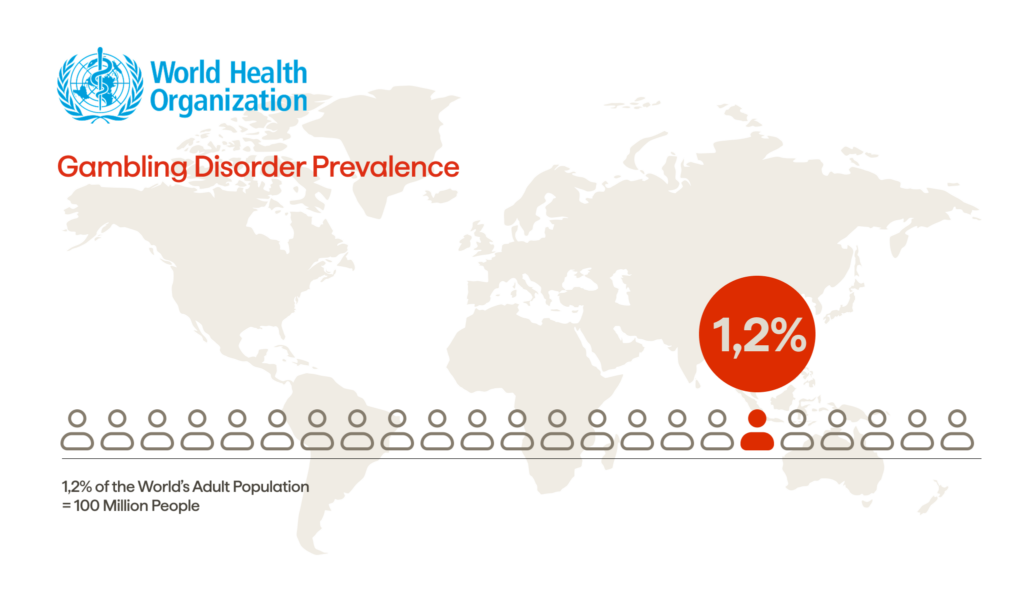
According to the World Health Organization (WHO), an estimated 1.2% of the world’s adult population suffers from a gambling disorder (Fig. 2). It means that out of 8.2 billion people, almost 100,000,000 individuals have serious problems with gambling.
The short version: boundaries beat willpower
Most people gamble as a form of entertainment, not as a financial plan. Still, product speed, notifications, and frictionless payments can change behavior fast. McKinsey’s 2025 consumer research points to a simple truth: people spend a large share of free time alone, and many shopping choices now happen online, which makes “impulse moments” more common.
The longer version: the system matters
A single “play safe” banner does not move the needle. A framework of small product decisions does. You set time before you start, you use time limits, and you treat a break from gambling like a normal part of the night. That is how people gamble more calmly, and more predictably.
Responsible gaming: When the fun stays fun. And when it doesn’t
Responsible gaming lives in the details most players never consciously notice. It shows up in how a session starts, how choices appear on screen, and how easy it is to pause or leave. In online gaming, these moments happen fast, which makes design decisions even more important. When details work together, play stays enjoyable. When they don’t, control slips quietly.
Definitions people can actually use
Responsible gaming refers to prevention and support methods that reduce harm across gaming activities. In plain language, gaming refers to a set of choices that shape the experience: how rules display, how bonuses trigger, and how exits work.
Attention is a design decision
McKinsey’s 2025 “attention equation” research (7,000 consumers worldwide, including 3,000 in the United States) argues that quality of attention matters more than raw time spent, and it ties that attention to monetization outcomes. That creates a real duty of care for any gaming and gambling product that competes for focus.
If the product “wins” attention by pushing people into autopilot, the business takes on risk, reputational, regulatory, and human.
Problem gambling: When a bet turns into a burden
Problem gambling rarely announces itself. It grows quietly, often behind normal routines and everyday responsibilities. To address problem gambling early, it helps to understand how small behavioral shifts form patterns long before a crisis appears.
Where patterns start
A gambling problem rarely begins with a dramatic crash. It usually starts with small changes in gambling behavior:
- hiding play;
- chasing losses;
- spending more to feel the same rush.
Those shifts can signal excessive gambling, even when someone still shows up to work.
A note for teams: harm spreads
Families can be affected by problem gambling long before a player hits a crisis moment. That is why early prompts, easy limit setting, and clear support routes matter for every operator, not just for “high-risk” accounts.
Keep in mind, prevention works best when it feels timely, human, and normal.
Casino logic, digital speed: How casino teams can keep play responsibly
Casinos now operate at two speeds at once, the physical pace of the gaming floor and the instant feedback loop of internet gaming. That mix creates opportunity, but it also creates pressure. Keeping play responsible means designing for both worlds without letting speed overpower judgment.
The market will not slow down for you
Statista’s Digital Market Insights data gets cited widely across the sector, including projections for large market growth through 2029 in the US. That growth raises the bar for player protection, especially across casinos and online products.
A practical operator stance
If you want one sentence to guide product choices, use this: promote responsible gaming at the exact moment a player makes a decision, not after the session ends. That means limits, prompts, and safer defaults at deposit, wager, and promo entry points.
Also, keep marketing honest. Promote responsible gambling in ads and onsite flows, or regulators will do it for you, and they will not be polite about it.
Responsible gambling tools that players actually use
Responsible gambling tools only work when people use them. The gap between “available” and “adopted” is where real risk hides. For gambling operators, this gap often signals a design or communication problem, not a lack of features.
What Deloitte’s 2025 evidence says
Deloitte Access Economics tested spending limits inside banking apps and found that adding spending limits increased engagement with harm-minimisation tools by about 20%. The same report notes that roughly three in four people were not aware of existing harm-minimisation tools, and that about 90% of moderate-risk and problem gamblers in the study chose a harm-minimisation option when offered.
Table: player controls vs operator controls
The table below shows how player-facing controls and operator responsibilities need to work together. One side without the other leaves gaps that players fall through.
| Control area | Player-facing option | Operator-facing requirement | What it reduces |
|---|---|---|---|
| Spending | Spending limits in account or banking layer | Clear UI, friction for raising limits | Impulse deposits |
| Time | Session reminders, and time limits | Neutral messaging, no shame tone | “Lost track of time” play |
| Access | self-exclusion and cooling-off | Identity linkage, marketing suppression | Return-to-play loops |
| Promotions | Opt-out of promo nudges | Targeting rules, review gates | Triggered relapse moments |
| Support | gambling help links, and a helpline route | Escalation playbooks, staff training | “Nowhere to go” moments |
Tools alone do not solve harm, but well-designed tools change behavior. When limits feel easy, exits feel safe, and support feels reachable, players are far more likely to stay in control. And far less likely to disappear when they need help most.
Self-exclusion: The “pause button” that must work
Self-exclusion is one of the clearest signals a player can give: “I need distance.” Respecting that signal is central to the principles of responsible design. When self-exclusion fails, trust breaks instantly, which is why it must behave less like a feature and more like infrastructure.
What good looks like
A self-exclusion program must be easy to start, hard to bypass, and clear about scope. It should block logins, stop promo contact, and prevent “just checking my balance” behavior that can restart cravings.
What often breaks
Teams sometimes treat self-exclusion like a customer service ticket. That is backwards. It is a safety mechanism, and it needs the same reliability standards as payments.
Helpline moments: When the product needs a human exit
Not every situation can be solved by UX or automation. Some moments require a human voice, quickly and without friction. In the gambling industry, a visible helpline is not a last resort — it is part of a responsible system’s safety net.
Make support visible, not buried
Every product should show a problem gambling helpline path, plus local resources, inside the account area, and at risk points (deposit failure loops, repeated session extensions, or repeated bonus claims).
Name the right organisations
In the U.S, the National Council on Problem Gambling serves as a key nonprofit directory and awareness hub, and many programs reference it in player-support content.
This is also where education matters: copy needs to sound human, not legal.
Responsible gambling is product work, not PR. At Avenga, we build limits, self-exclusion, and clear support paths into the core flows, so players keep control, and operators earn trust.
Darko Dimitrievski
Director of Delivery at Avenga
Rules, receipts, and reality checks: Gaming regulations without the paperwork headache
Regulation is often treated as a constraint. In practice, it is a mirror. Responsible gaming rules show how much a company cares about risk, honesty, and doing things the same way every time. When teams plan for these rules from the start, following them becomes a normal part of the work, not something added later.
Regulators want proof, not promises
A gaming commission, or a gaming control board, will definitely ask three key questions:
- How do you handle risk?
- How do you document actions?
- How do you show consistent decisions across teams?
Your internal laws and regulations mapping needs to connect product, support, and marketing.
Use one clear standard
Publish a code of conduct for responsible play, and train teams on conduct for responsible gaming across product, CX, and marketing. Treat industry best practices as the baseline, not as a “nice to have.”
Underage risk and gambling addiction: The hard stuff nobody can ignore
Some risks leave no room for debate. Underage access and gambling addiction demand early action, clear systems, and people who know how to respond.
Underage is not a “minor” problem
When underage users reach gambling sites, the product normalises risk early. Add strong verification, but also watch the funnel and ad placement. Minors often get in through partner sites, influencer posts, and poor ID checks. See underage gambling as a rule and safety problem, not just a public image problem.
Addiction needs both design and people
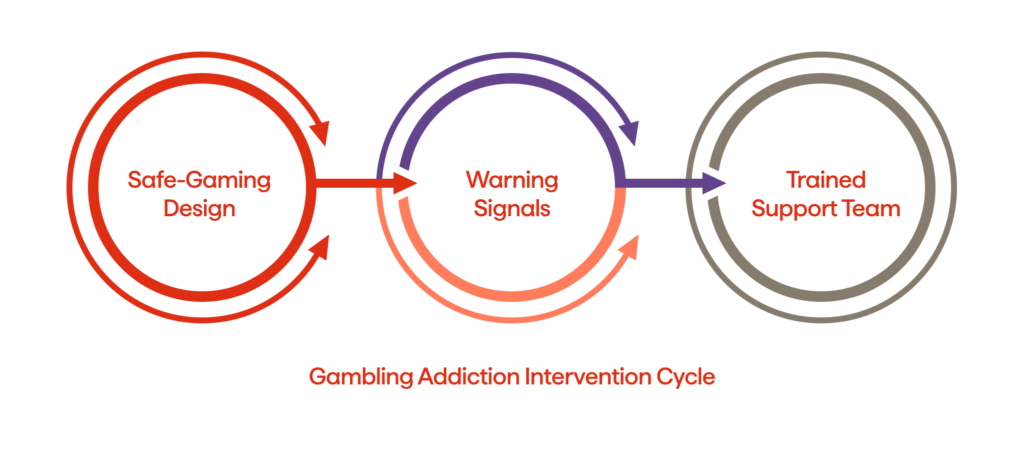
Gambling addiction shows up in cycles, not in a single moment. Create a safe-gaming program that sends warning signs to support teams, and train employees to know how to talk to customers and what to avoid saying.
“Someone you know” might be in trouble: What to say when you suspect risk
Spotting risk in someone close to you can feel uncomfortable. Saying something early, and saying it calmly, often matters more than saying it perfectly.
Keep it simple. Keep it calm
If someone you know might have a gambling problem, talk about what you have noticed, not what you think. Ask if the person feels in control, and suggest choices like setting limits, taking a break from gambling, or getting help.
Common signs of problem gambling include:
- Hiding play, or lying about losses
- Repeated “just one more” sessions late at night
- Borrowing money, or using credit card advances
- Mood swings around wins and losses, and irritability when not playing
If you know has a gambling problem, avoid paying off debts in a way that fuels the loop. Offer support, boundaries, and a next step.
Gaming in new markets: What changes, what stays, and what comes next
New markets bring growth fast, and risk just as quickly. Scaling responsibly means keeping player protection steady while everything else accelerates.
Growth raises the risk surface
Statista-linked forecasts show that there will be more users and higher earnings in the next few years, which means companies will get more attention, face more careful checks, and have higher expectations from everyone involved.
A forward-looking view for operators
Here is a checklist/playbook for operators entering new jurisdictions:
- Align product and compliance early, before launch deadlines dictate compromises.
- Lock defaults: limit prompts should not depend on “optional settings.”
- Treat ad review like a safety gate, because advertising can trigger relapse.
- Monitor cross-product behavior across online casino, sports betting, lottery, and land-based channels.
- Run continuous risk review around responsible systems, and publish outcomes internally.
You will also need to keep language consistent around safer gambling, and keep reporting clean across state gaming structures.
Concluding remarks or what to remember
Here’s a quick recap of what you need to take from the piece above:
- Responsible gambling works best as product defaults plus clear support, not as fine print.
- Self-exclusion must work reliably, and it must stop marketing contact.
- A visible support path, including a helpline, prevents “no exit” moments.
- Treat underage access as a safety and compliance priority, because it predicts future risk.
- Document controls for regulators, and keep one clear code of conduct across teams.
Responsible gambling is more a philosophy and a mindset than a one-off practice. When dealing with iGaming solutions, it is crucial to keep the intricacies of human psychology in mind. This is exactly what our iGaming development services are founded on.
Contact our team and get to know the inner workings of responsible gambling.


Game Theory Attribution: The Model You’ve Probably Never Heard Of

What Is Gambling Advertising?
Your business results matter
Achieve them with minimized risk through our bespoke innovation capabilities. Fill in the form below.